Sample Scored Feedback Report
A complete feedback report on a Write an Email practice response, annotated part by part — so you know exactly what scored practice produces before you pay for it.
This resource is free to read, print, and share. AI-scored practice with feedback is a separate paid Writing30 feature.
What this is: a demonstration report. The email below was written as a practice response for this sample (the writer persona is "Daniel"), then scored by the same pipeline that scores paid practice. It is not a customer's result and makes no claim about anyone's score improvement.
The report
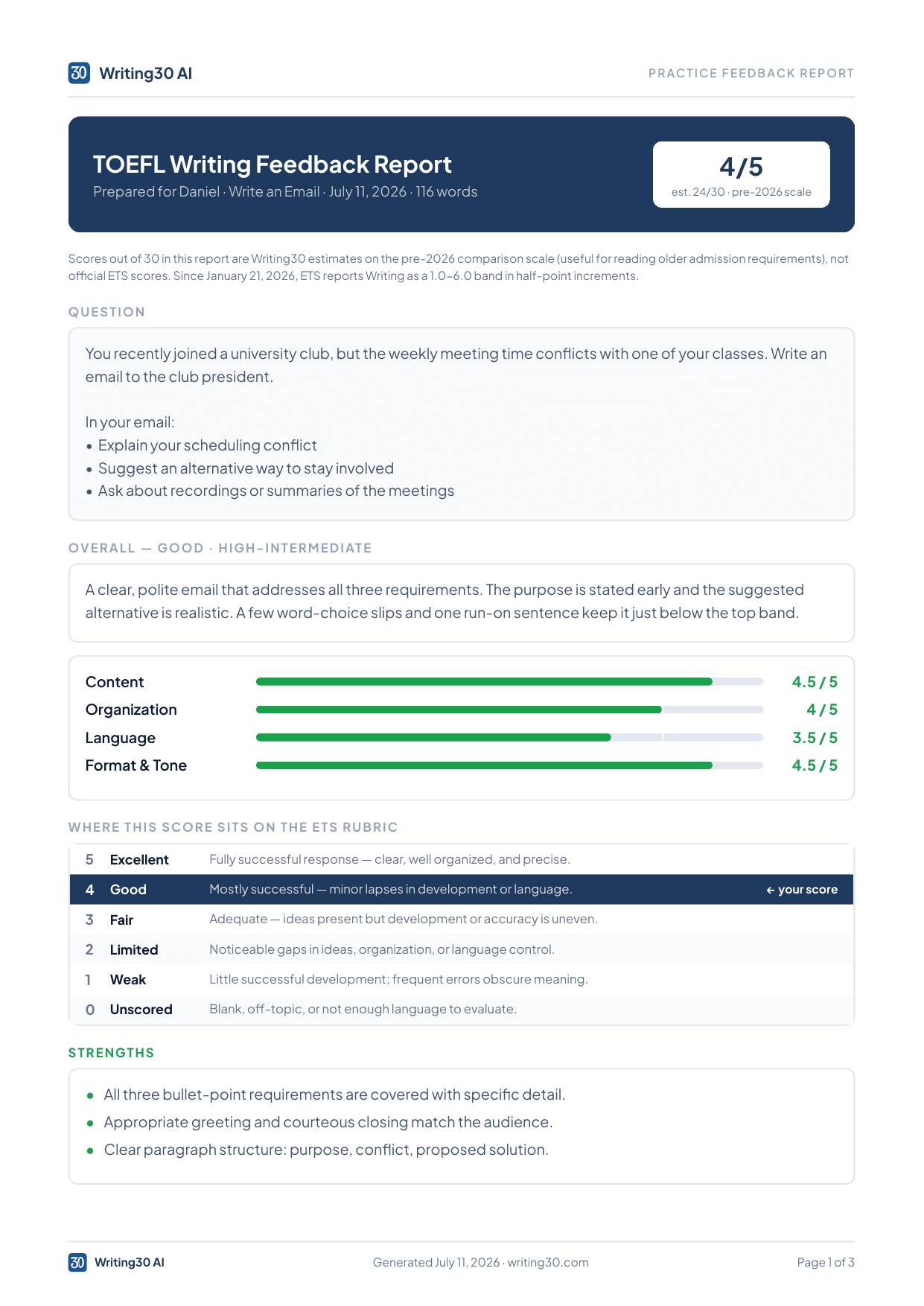
Download the full two-page PDF with the button above, or read the first page here:
How to read each part
1. The 0-5 rubric score
The badge in the header shows the task score: 4/5. The two open-response TOEFL writing tasks (Write an Email, Academic Discussion) are scored on a 0-5 rubric; Writing30 scores practice in half-point steps so you can see movement between bands. Under the overall score, the report breaks the rubric into dimensions — for an email: Content (4.5), Organization (4), Language (3.5), and Format & Tone (4.5). The weakest dimension tells you what to practice next; here it is language accuracy, not structure.
2. The separate /30 estimate
The smaller line under the badge — est. 24/30 — is a different number on a different scale, and the scale needs a precise label. Since January 21, 2026, ETS reports the Writing section as a band from 1.0 to 6.0 in half-point increments (ETS: understanding your scores). The 0-30 section scale belongs to the previous format — but most university requirements were published on it, so Writing30 also estimates where a performance like this would land on that prior, comparison scale. Three honesty rules apply: the /30 figure is an estimate, it refers to the pre-2026 scale rather than the current reporting format, and it is shown separately from the rubric score instead of blended into it.
3. Strengths and areas to improve
Both lists are specific to the response, not generic advice. In this sample the strengths note that all three required bullet points are covered; the areas to improve name one run-on sentence and one unnatural collocation ("make a participation").
4. Suggested fixes with rewrites
Each flagged problem comes with a before/after rewrite. The run-on — "I have a required lecture at that time and I cannot change it and I really want to stay in the club." — becomes two sentences, with a one-line explanation of why the split sharpens the request. Fixes are written so you can apply the same pattern to your next response, not just patch this one.
5. One Score Higher
In the app (this part lives in the interactive report rather than the PDF), the feedback ends with One Score Higher: a rewritten version of your own response that would score half a band higher — for this sample, taking the 4 toward a 4.5. Every change is highlighted in the rewritten text and tied to a numbered improvement, with the estimated /30 range shifting accordingly. The point is to show the minimum edits that lift the score, so you learn which habits matter instead of memorizing a perfect model answer.
What is free and what is paid
- Free: this sample report and PDF, plus public scored samples, practice topics, and the printable Write an Email task pack.
- Paid: getting reports like this on your own timed responses — AI-scored practice is part of the Writing30 subscription (see pricing). There is no free trial or free scoring allowance.
Teachers: the Teacher Kit suggests projecting this report when you introduce rubric-based peer review.
Want scored practice for Write an Email?
Writing30 scores timed practice on the 0-5 task rubric, with a separate estimate on the pre-2026 /30 scale, specific fixes, and One Score Higher. Scored practice is a paid subscription — this resource stays free either way.
See how scored practice worksFree to print and share for classroom and personal study use with attribution to writing30.com. Please do not resell or claim authorship.