TOEFL 2026 Changes: Complete Guide to New Writing Format
Quick Answer
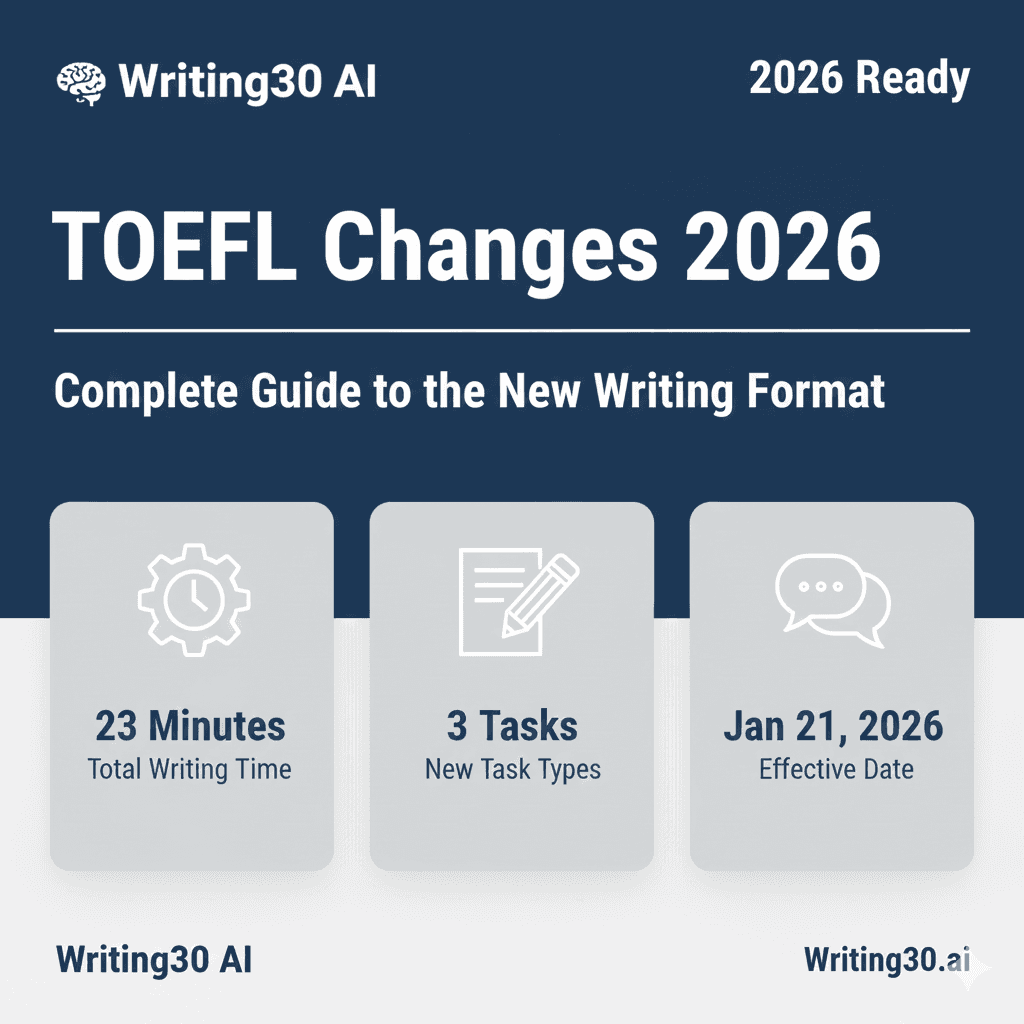
Yes, the TOEFL writing section changed significantly on January 21, 2026. The old Integrated Writing and Independent Writing essays were replaced with three new tasks: Build a Sentence (~6 min), Write an Email (~7 min), and Academic Discussion (~10 min). The total writing time decreased from 50 minutes to approximately 23 minutes.
Key Takeaways
- ✓Changes took effect January 21, 2026 — all tests after this date use the new format
- ✓Three new task types replace the two old essay formats
- ✓Total writing time reduced from 50 minutes to approximately 23 minutes
- ✓Build a Sentence is entirely new, testing grammar and word order accuracy
- ✓Write an Email tests practical professional communication skills
- ✓Academic Discussion is similar to the old Independent task but shorter and more focused
Watch: TOEFL 2026 Changes Explained
Video overview of the TOEFL iBT test format and what to expect
Important Date: January 21, 2026
The TOEFL iBT writing section changes take effect on January 21, 2026. Tests before this date use the old format. Plan your test date accordingly.
TOEFL 2026 Format Overview: Will TOEFL Change in 2026?
Yes, the TOEFL iBT is changing significantly in 2026[1]. Effective January 21, 2026, the writing section undergoes a fundamental transformation[2]. ETS (the test maker) is replacing the traditional essay-based assessment with shorter, more practical communication tasks.
TOEFL 2026 Writing Section at a Glance
What Changed: Old TOEFL vs TOEFL 2026 Format Comparison
The TOEFL test changes 2026 represent the biggest update to the writing section in years. Here's a direct comparison of what's different:
| Aspect | Old Format (Before 2026) | New Format (2026) |
|---|---|---|
| Total Time | 50 minutes | 23 minutes |
| Number of Tasks | 2 tasks | 3 tasks |
| Task 1 | Integrated Writing (20 min) | Build a Sentence (~6 min) |
| Task 2 | Independent Writing (30 min) | Write an Email (~7 min) |
| Task 3 | N/A | Academic Discussion (~10 min) |
| Reading/Listening | Required for Integrated Task | Not required |
| Response Length | 150-300+ words per essay | 80-150 words per task |
What's Gone
- ✕Integrated Writing Task (read + listen + write)
- ✕Independent Writing Essay (300+ word argumentative essay)
- ✕Long-form essay structure requirements
- ✕50-minute writing marathon
What's New
- Build a Sentence (grammar-focused task)
- Write an Email (professional communication)
- Academic Discussion (engage with peers)
- Shorter, focused 23-minute section
The Three New TOEFL 2026 Writing Tasks Explained
Build a Sentence (~6 minutes)
This new task tests your English grammar by giving you scrambled words to arrange into a correct sentence. You'll complete 4-6 items, each requiring you to organize words into proper English word order.
Example:
Arrange these words: were | the | was | old city | showed us around | who | tour guides | fantastic
Answer: "The tour guides who showed us around the old city were fantastic."
Scoring: Correct or Incorrect (no partial credit)
Read our Build a Sentence Strategies GuideWrite an Email (~7 minutes)
Write a professional email responding to a realistic scenario. You'll need to accomplish 3 communicative goals (like explaining a problem, asking a question, or expressing an opinion) — ETS sets no word count here, and 80-120 words is a comfortable practice target.
Example Scenario:
A poetry magazine had a submission form issue. Write to the editor to: (1) Tell them what you like about the magazine, (2) Describe the problem, (3) Ask about your submission status.
Scoring: 0-5 rubric based on goal achievement, tone, organization, and grammar
Read our Email Writing GuideAcademic Discussion (~10 minutes)
Respond to a professor's question in an online class discussion. You'll read two peer responses first, then write your own contribution of at least 100 words (target 100-150) expressing your opinion and engaging with your classmates' points.
Example Prompt:
"Should high school students be required to do volunteer work? Why or why not?"
You'll see two student responses (one agreeing, one disagreeing) before writing yours.
Scoring: 0-5 rubric based on position clarity, peer engagement, reasoning, and grammar
Read our Academic Discussion GuideHow is TOEFL 2026 Writing Scored?
The TOEFL 2026 scoring system differs by task type:
| Task | Scoring Method | What's Evaluated |
|---|---|---|
| Build a Sentence | Correct/Incorrect | Grammar accuracy, word order |
| Write an Email | 0-5 Rubric | Goal achievement, tone, organization, grammar |
| Academic Discussion | 0-5 Rubric | Position clarity, peer engagement, reasoning, grammar |
Score 5 (Highest) Requirements
- Email: All 3 goals accomplished with specific detail, appropriate professional tone
- Discussion: Clear position with strong support, thoughtful peer engagement
- Both: Consistent grammatical accuracy, clear organization, effective communication
How to Prepare for TOEFL 2026: Preparation Tips
The TOEFL 2026 preparation strategy differs significantly from the old format. Here's how to prepare effectively:

Effective TOEFL preparation requires focused practice with the new task formats
1. Master English Grammar Fundamentals
The Build a Sentence task directly tests grammar. Focus on:
- Subject-verb agreement
- Word order in questions and statements
- Relative clauses (who, which, that)
- Modifier placement (adjectives, adverbs)
- Prepositional phrases
2. Practice Professional Email Writing
The email task requires a specific tone and structure:
- Use formal greetings (Dear Editor, Dear Professor)
- State your purpose clearly in the opening
- Address all 3 required points
- End with a professional closing
- Keep it concise — target 80-120 words
3. Develop Discussion Skills
The Academic Discussion requires engagement with peers:
- Always reference what other students said
- State your position clearly in sentence 1
- Provide 2-3 supporting reasons
- Use transition words (however, moreover, therefore)
- Write at least 100 words — 100-150 is a good practice target
4. Time Management Practice
The 23-minute time limit is strict. Practice with these allocations:
- Build a Sentence: ~1 minute per item
- Email: 1 min read, 5 min write, 1 min review
- Discussion: 2 min read, 7 min write, 1 min review
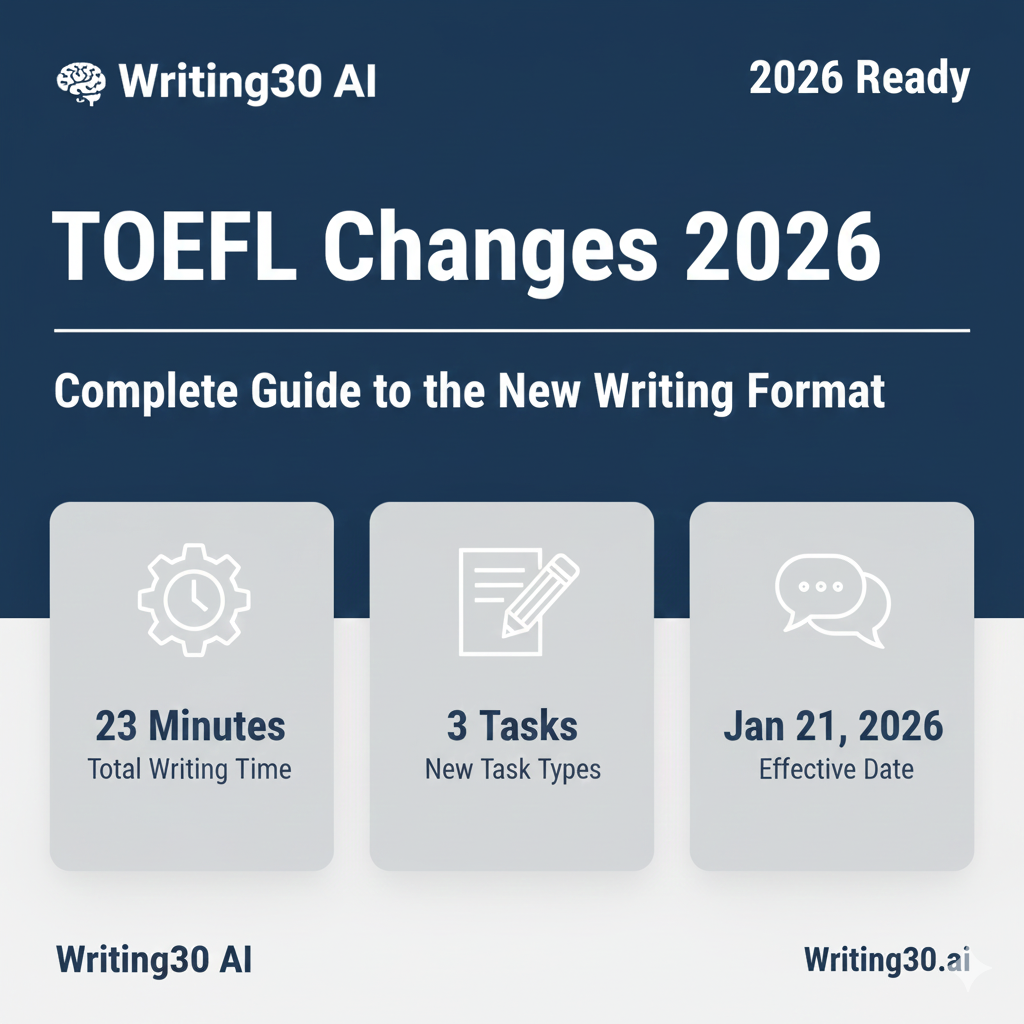
Visual Summary: TOEFL 2026 Changes at a Glance
Save or bookmark this infographic for quick reference. It summarizes all the key changes to the TOEFL Writing section effective January 21, 2026, including the new task types and scoring.
Practice for TOEFL 2026 Now
Get instant AI feedback on all three TOEFL 2026 task types.
Try Writing PracticeFrequently Asked Questions About TOEFL Changes 2026
Will TOEFL change in 2026?
Yes, the TOEFL iBT writing section changes significantly on January 21, 2026. The Integrated and Independent essays are replaced with three new tasks: Build a Sentence, Write an Email, and Academic Discussion. Total writing time decreases from 50 to 23 minutes.
When do the TOEFL 2026 changes take effect?
The changes take effect on January 21, 2026. If you take the TOEFL before this date, you'll use the old format. Tests on or after January 21, 2026 use the new format.
Is the TOEFL 2026 format easier or harder?
It depends on your strengths. The new format is easier if you have strong grammar skills and struggle with long essays. It may be harder if you excelled at extended writing but have weaker grammar fundamentals. The shorter time (23 vs 50 minutes) reduces fatigue but requires faster thinking.
Do I need to practice reading and listening for the new writing section?
No. The TOEFL 2026 writing section is standalone. Unlike the old Integrated Task that required reading a passage and listening to a lecture, all three new tasks only require writing skills.
How long should my responses be in TOEFL 2026?
Write an Email: no set ETS word count — target 80-120 words (about 8-12 sentences)
Academic Discussion: at least 100 words, target 100-150 (about 10-15 sentences)
Build a Sentence: One sentence per item (4-6 items total)
Should I take the TOEFL before or after January 2026?
Consider the old format if you're comfortable with long essays and have strong synthesis skills. Choose the new format if you prefer shorter tasks, have strong grammar, or dislike the Integrated Task. Both formats test valid English skills—choose based on your strengths.
References & Further Reading
- TOEFL iBT Test Content and Structure — ETS Official Website (Accessed: December 2025)
- TOEFL iBT Writing Section Updates 2026 — ETS TOEFL Preparation (Accessed: December 2025)
- TOEFL iBT Test Scores and Score Reports — ETS Official Website (Accessed: December 2025)
- TOEFL iBT Free Practice Test — ETS Free Resources (Accessed: December 2025)
- Understanding TOEFL iBT Scores — ETS Score Users Guide (Accessed: December 2025)
External links open in a new tab. Writing30 is not affiliated with the linked sources.
Guides for Other TOEFL Sections
Tags
Ready to Improve Your TOEFL Writing?
Get instant AI-powered feedback on your TOEFL writing. Practice with real prompts and see your score improve.
Try Writing30 AI