Your TOEFL Writing Template for a High Score in 2026
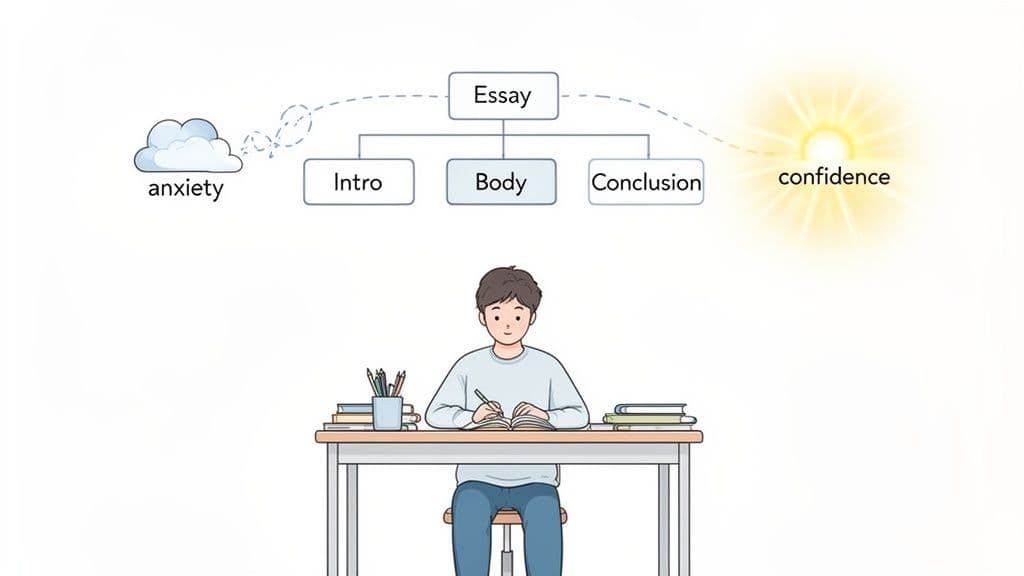
Feeling that clock-ticking pressure in the TOEFL writing section? You're not alone. The demand to produce clear, well-supported responses under pressure creates a ton of anxiety. This is exactly where a smart essay writing template becomes your secret weapon for success on the 2026 TOEFL.
This isn't about memorizing robotic phrases. It's about internalizing the logical framework high-scorers use to organize their thoughts on the fly. This structure ensures you hit every scoring requirement for all three writing tasks: Build a Sentence, Write an Email, and Academic Discussion.
Why a Template Can Boost Your TOEFL Writing Score

A template takes the guesswork out of the equation. When you know exactly how to start, what to include in the middle, and how to wrap up, you free up mental energy to focus on what really matters: your ideas and your English. You can face test day with a feeling of control, ready for any question.
The benefits are immediate:
- Time Management: It helps you budget your time across the three tasks, so you're not stuck scrambling to finish. You know exactly how long to spend on each part.
- Complete Responses: It acts as a mental checklist, reminding you to state a clear opinion, provide supporting reasons, and include specific examples, which are key to a high score.
- Structure and Coherence: It gives your writing a logical flow, making your arguments easy for the human and AI scorers to follow and appreciate.
This structured thinking is especially critical for the 2026 TOEFL format, effective January 21, 2026. While a full essay template applies most directly to the Academic Discussion task, the principles of structure are vital for hitting all the requirements in the Write an Email and Build a Sentence tasks, too.
TOEFL 2026 Writing Template Quick Guide
| Task Type | Template Focus | Key Skill Tested |
|---|---|---|
| Academic Discussion | Opinion, reasoning, and peer contribution structure | Argumentation & Synthesis |
| Write an Email | Greeting, purpose, details, and closing format | Practical Communication |
| Build a Sentence | Common sentence patterns (SVO, relative clauses) | Grammatical Accuracy |
This table shows how a "template" is really just a reliable structure adapted for each specific task.
A strong template doesn't limit creativity; it enables it by providing a reliable foundation. You can build a much stronger house when you're not worried about the foundation crumbling.
By mastering the logic behind a good template, you’ll be ready to tackle any prompt with confidence. If you want to dive deeper into how your writing is judged, check out our guide on the official TOEFL writing scoring criteria. In the next sections, we'll provide specific templates you can start practicing with right away.
A Template for the Academic Discussion Task

The Academic Discussion task asks you to jump into an ongoing online class discussion. It can feel a little unpredictable, but having a solid essay writing template is like having a reliable game plan. It lets you respond to any point with confidence.
Don't mistake this for a full five-paragraph essay. Your job is to write a clear, concise, and well-supported post of at least 100 words in just 10 minutes. Think of it as adding one strong, valuable point to the conversation that contributes to the discussion.
A Simple, Effective Structure
The best approach here is a simple, four-part structure that helps you hit all the key scoring points. It's flexible enough for any topic but gives you the framework you need when the clock is ticking.
Here’s a breakdown you can practice until it becomes second nature:
- Acknowledge & State: Briefly mention the ongoing discussion or a specific point from another student. Then, clearly state your own opinion.
- Support with a Reason: Give one strong reason that backs up your position. This is the heart of your argument.
- Give a Specific Example: Make your reason more convincing with a concrete example. This can come from your personal experience, general knowledge, or even a quick hypothetical.
- Conclude Briefly: Wrap it up with a single sentence that summarizes your point or highlights its importance.
Following this structure makes your response well-developed and easy for the graders to follow—two things they are specifically looking for to award a high score (4-5 points).
Sample Response and Analysis
Let's see this template in action. Imagine the professor's question is: "Is it more beneficial for students to study in groups or to study alone?"
Another student, "Maria," has just posted that group study is great for motivation. Here’s how you could jump in using the template:
I see Maria’s point about group study being motivating, but I believe studying alone is ultimately more effective for deep learning. When I study by myself, I can focus entirely on my weakest areas without being distracted by topics my peers already understand. For example, while preparing for a biology exam last semester, I spent three hours just on cellular respiration because I found it difficult, something I couldn't have done in a group. This focused effort helped me truly master the concept and score well on the test. Ultimately, this personalized approach is crucial for genuine comprehension.
Let's break down why this works. It starts by acknowledging another student ("I see Maria's point..."), states a clear counter-position ("...studying alone is more effective"), gives a strong reason (focusing on weak areas), supports it with a perfect personal example (the biology exam), and ends with a strong concluding thought. It's concise, adds a new idea, and shows strong reasoning. That's exactly what a high-scoring response looks like. You can try this structure yourself with our practice tool at Writing30.
To make your arguments even more powerful, check out our guide on how to effectively handle counterclaims and rebuttals.
Crafting the Perfect Email Response

The ‘Write an Email’ task throws you into realistic campus situations—asking a professor for help, clarifying a club meeting time, or requesting information from a university office. It’s a practical test of your communication skills.
Don't sweat it. You just need a simple, effective email writing template to guide your response. Following a proven structure ensures you hit every point the scorers are looking for, so you can focus on getting your message across clearly and politely. This task is all about showing you can navigate a real-world academic environment.
Your Go-To Email Template
Think of this structure as your roadmap for any email scenario the TOEFL gives you. By following this simple format, you’ll avoid rambling and make sure your email is direct, professional, and easy for the recipient to understand.
Here’s the essential structure that works every time:
- Polite Greeting: Always start with "Dear Professor [Last Name]," or "Dear [Office/Department Name] Staff,".
- State Your Purpose: Get straight to the point in the first sentence. Use phrases like, "I am writing to inquire about..." or "I am writing to request...".
- Provide Key Context: Give the necessary background details. Mention the specific class, assignment, or issue so they know exactly what you’re talking about.
- Make a Clear Request: State precisely what you need. Are you asking for an extension, clarification on a requirement, or help with a specific problem? Be direct.
- Professional Closing: End politely with "Thank you for your time," or "I look forward to hearing from you," followed by your name.
This framework is your key to a high-scoring email. It shows you can communicate efficiently and respectfully—exactly what the official rubric rewards.
Annotated Example: Asking for Help
Let’s apply this template to a common scenario: you’re confused about an assignment and need to ask your professor for help.
Scenario: You aren't sure about the source requirements for the upcoming History 101 research paper.
Dear Professor Smith,
I am writing to ask for clarification regarding the research paper for your History 101 class, section B.
I have reviewed the syllabus and the assignment prompt, but I am still unsure about the required number of primary sources. The prompt mentions using "several sources," and I want to make sure I meet the expectation correctly.
Could you please let me know the minimum number of primary sources we should include?
Thank you for your guidance.
Sincerely,
[Your Name]
This email works perfectly. It’s specific ("History 101 class, section B"), shows the student has already tried to find the answer ("I have reviewed the syllabus"), and makes a direct, polite request. This is the exact level of clarity and professionalism scorers want to see. This is an actionable tip you can practice right now: write a sample email to a professor asking a question.
For even more examples and tips, check out our complete guide on TOEFL email writing.
Using a Mental Template for the Build a Sentence Task

The "Build a Sentence" task isn't an essay, but you absolutely need a template for it—a mental one. This task, part of the 2026 TOEFL format, is a rapid-fire test of your grammar. You have to build a logical sentence from a jumble of words, and you have to do it fast.
Think of it like a puzzle. A structured approach saves precious seconds and helps you avoid those simple mistakes that cost you points. The trick is having a mental checklist you can run through almost instantly.
Your Four-Point Mental Checklist
When the sentence fragments pop up on screen, don't panic and start dragging words. Take a breath, scan the pieces, and apply this quick four-point check. This process turns a confusing mess into a clear, high-scoring sentence.
- Find the Core: First, identify the main subject and verb. This is the backbone of your sentence, the independent clause that could stand on its own.
- Spot the Supporting Parts: Next, find any dependent clauses or phrases. These are the fragments that add detail but can't function as a complete sentence.
- Define the Relationship: How do the pieces connect? Look for clues. Are they showing contrast (but, although), cause and effect (because, since), or adding descriptive information (who, which)?
- Connect and Punctuate: Finally, join the clauses with the correct conjunctions and punctuation, like commas.
This systematic approach is your best defense against the clock. It gives you a clear path forward every single time.
Don't get lost trying to test every possible combination. By identifying the core subject and verb first, you anchor the sentence and make it much easier to attach the other pieces correctly. This is the fastest way to build a grammatically sound sentence.
Common Structures to Master
This task loves to test specific sentence patterns. If you can recognize them on sight, you have a massive advantage. Here are some of the most common structures you'll see.
| Sentence Structure Type | Example Fragments | Correctly Built Sentence |
|---|---|---|
| Complex Sentence | the university canceled classes / due to the severe snowstorm | The university canceled classes due to the severe snowstorm. |
| Participial Phrase | the student submitted his essay / hoping for a good grade | Hoping for a good grade, the student submitted his essay. |
| Relative Clause | the professor is highly respected / who teaches neuroscience | The professor who teaches neuroscience is highly respected. |
Notice how each structure links ideas in a specific, predictable way. Mastering these patterns is non-negotiable for this task. You can get more in-depth practice with these concepts and other advanced techniques in our full guide on TOEFL Build a Sentence strategies.
Filling Your Template with High-Scoring Language
A strong essay writing template provides the structure, but it's the language you fill it with that earns top scores. Think of the template as the blueprint for a house; powerful vocabulary and varied sentences are the high-quality materials that make it impressive.
TOEFL scorers are trained to look for lexical range (your vocabulary) and syntactic variety (your sentence structures). In simple terms, they need to see that you can express complex ideas without repeating the same basic words and sentence patterns.
Moving Beyond Simple Vocabulary
Words like "good," "bad," and "important" are functional, but they don't do you any favors. They're overused and lack the precision that scorers reward. A quick way to boost your score is to swap these common words for more sophisticated synonyms.
Take this simple sentence from an Academic Discussion post:
- "Group study is good because it is important to share ideas."
Now, let's upgrade the language:
- "Collaborative study is beneficial because it is essential to exchange diverse perspectives."
The second version sounds more academic, conveys a deeper meaning, and demonstrates a stronger command of English. You can practice this right now: open one of your old practice essays and find 3-5 simple words to replace with stronger alternatives.
A Quick-Reference Synonym List
Here are some high-impact synonyms to start incorporating into your practice. Don't just memorize the list; practice using each word in a sentence to get comfortable with its meaning and usage.
| Instead of... | Try Using... |
|---|---|
| Important | Crucial, essential, vital, significant, paramount |
| Good | Beneficial, advantageous, effective, valuable, favorable |
| Bad | Detrimental, harmful, negative, unfavorable, damaging |
| Show | Demonstrate, illustrate, reveal, indicate, highlight |
| Think | Believe, contend, argue, maintain, assert |
Connecting Your Ideas Like a Pro
Transition words are the signals that guide your reader through your argument. They connect your template's different parts, ensuring your logic flows smoothly from one point to the next. This is critical in both the Academic Discussion and Write an Email tasks.
Here are some essential transitions organized by their function:
- To Add an Idea: Furthermore, moreover, in addition, additionally
- To Show Contrast: However, nevertheless, on the other hand, conversely
- To Provide an Example: For instance, for example, to illustrate, specifically
- To Show a Result: Consequently, therefore, as a result, thus
A common mistake is using these words randomly. They are signposts for your reader. "However" signals a change in direction, while "Furthermore" tells the reader you are adding another piece of supporting evidence.
Using transitions correctly is a major factor in your coherence score. The AI feedback on Writing30 is specifically designed to catch repetitive phrasing and suggest better vocabulary and transitions, helping you master this skill much faster.
By combining a solid template with powerful, precise language, you create a response that is both organized and sophisticated. That's the formula for a top-tier TOEFL Writing score.
Your Final Checklist for Test Day Success
You've got the templates and the strategies. Now, the final push is about moving from knowing what to do to doing it automatically, without a second thought. This journey can feel stressful, but every practice test you take builds the confidence you need.
This isn’t about memorizing rigid formulas. It's about internalizing a flexible framework that you can twist and shape to fit any question the 2026 TOEFL throws at you. The real goal is to walk into that test center feeling in control.
Here’s a quick mental run-through to get you there.
- Adapt, don't just memorize. Can you take the core structure—opinion, reason, example—and apply it to any Academic Discussion prompt you see? Test yourself. Don't just repeat; adapt.
- Make your mental templates automatic. For a Build a Sentence item, is your process for spotting the subject, verb, and any clauses completely second nature? It needs to be.
- Own the clock. Have you drilled each task under strict, timed conditions? On test day, time management is just as crucial as the quality of your writing.
True confidence doesn't come from just reading, it comes from doing. The best way to silence test-day anxiety is by practicing until you know, for a fact, that you can produce a solid response under pressure. That's what secures a high score.
The most direct way to turn this knowledge into points is to apply it. Use the templates you've learned on real practice questions and see exactly where you stand.
Take the next step right now. Try a free practice question on Writing30 and get instant, AI-powered feedback based on the official 2026 TOEFL rubric.
Your TOEFL Template Questions Answered
I get it. The idea of using an essay writing template can feel a little bit like cheating, or worse, like it will make your writing sound robotic. I hear these worries all the time from anxious students.
Let's clear the air. A good template is a launchpad, not a cage. When used correctly, it gives you structure and confidence, freeing you up to focus on your ideas. Let's tackle the most common questions I get.
Will My Writing Sound Robotic?
Absolutely not—if you do it right. Think of a template as the skeleton of your response. It provides the basic structure, but it’s your unique examples, vocabulary, and arguments that add the muscle and personality.
The goal is never to just memorize and plug in generic phrases. For the Academic Discussion task, your template might follow a simple [State Opinion] > [Explain Why] > [Give Example] flow. But it's your specific example about a research project or a personal experience that makes the post sound like you and contributes meaningfully to the discussion.
How Can I Remember It All Under Pressure?
Don't memorize—internalize the logic. Trying to recall exact sentences when the clock is ticking is a recipe for panic. Instead, understand why the template is structured the way it is.
For the Write an Email task, the logic is universal: be polite, say why you're writing, give some context, ask for what you need, and sign off. Once you get the flow, the right words will follow naturally. This is a skill you can build through consistent practice.
Forget about memorizing sentences. Focus on the sequence of ideas. "First, I state my position. Next, I give my reason. Then, I back it up with an example." That simple, logical path is much easier to recall under pressure than a rigid script.
Do I Need Different Templates for Different Prompts?
You need to adapt, not start from scratch. Your core template for the Academic Discussion task, for example, is surprisingly flexible.
If the prompt asks you to agree or disagree, your main point is your position. If it asks for a solution to a problem, your main point becomes your proposed solution, and your reasoning explains why it will work. The fundamental structure—state, support, exemplify—holds.
Mastering this skill of adapting a core framework is what separates high-scorers (scores of 25-30) from everyone else. Your response will always feel custom-fit to the question. To see exactly what scorers are looking for, check out our detailed guide on the TOEFL writing rubric.
Ready to put these strategies into practice? The fastest way to build test-day confidence is to try a free practice question on Writing30. You’ll get instant, AI-powered feedback based on the official 2026 TOEFL rubric. Get started for free at writing30.com.
Ready to Practice?
Try all 3 TOEFL 2026 writing tasks with instant AI feedback.
Tags
Ready to Improve Your TOEFL Writing?
Get instant AI-powered feedback on your TOEFL writing. Practice with real prompts and see your score improve.
Try Writing30 AI