Official TOEFL 2026 Writing Rubrics: Complete Scoring Guide
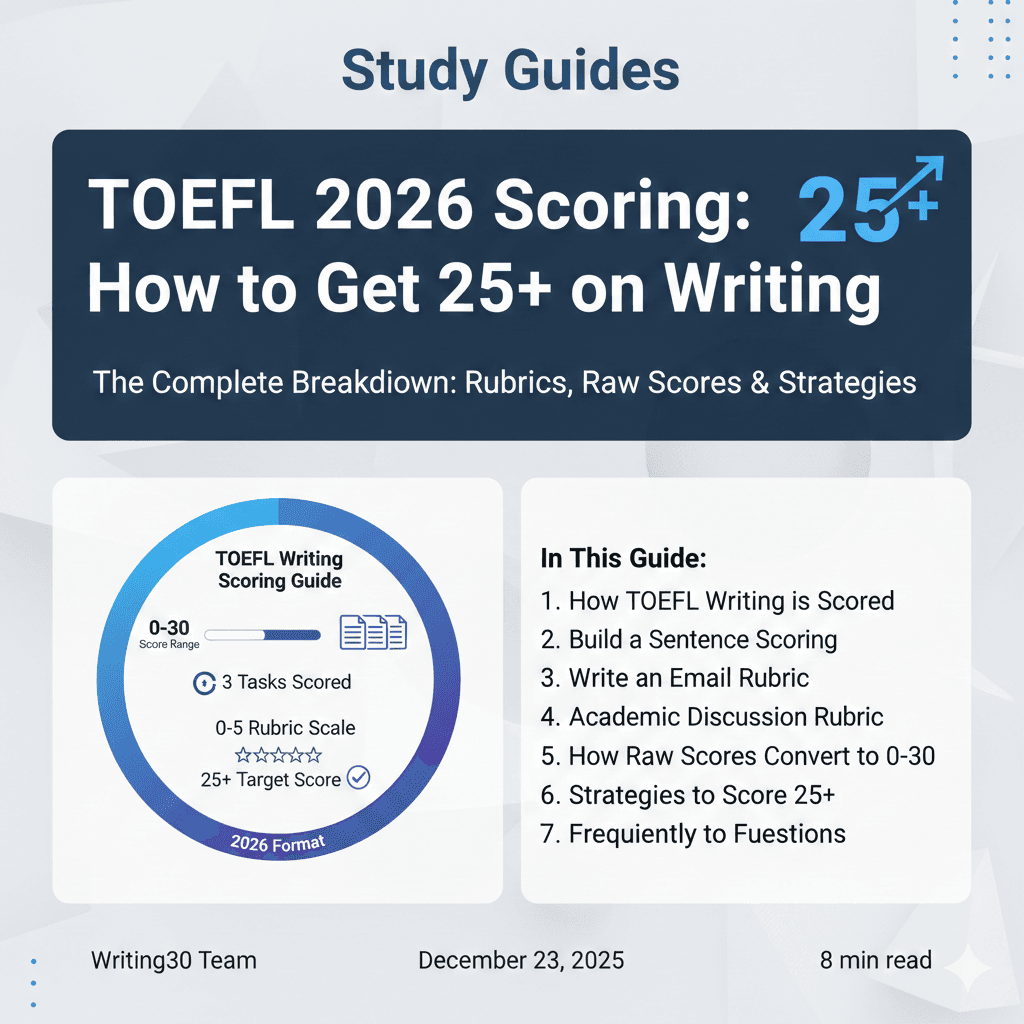
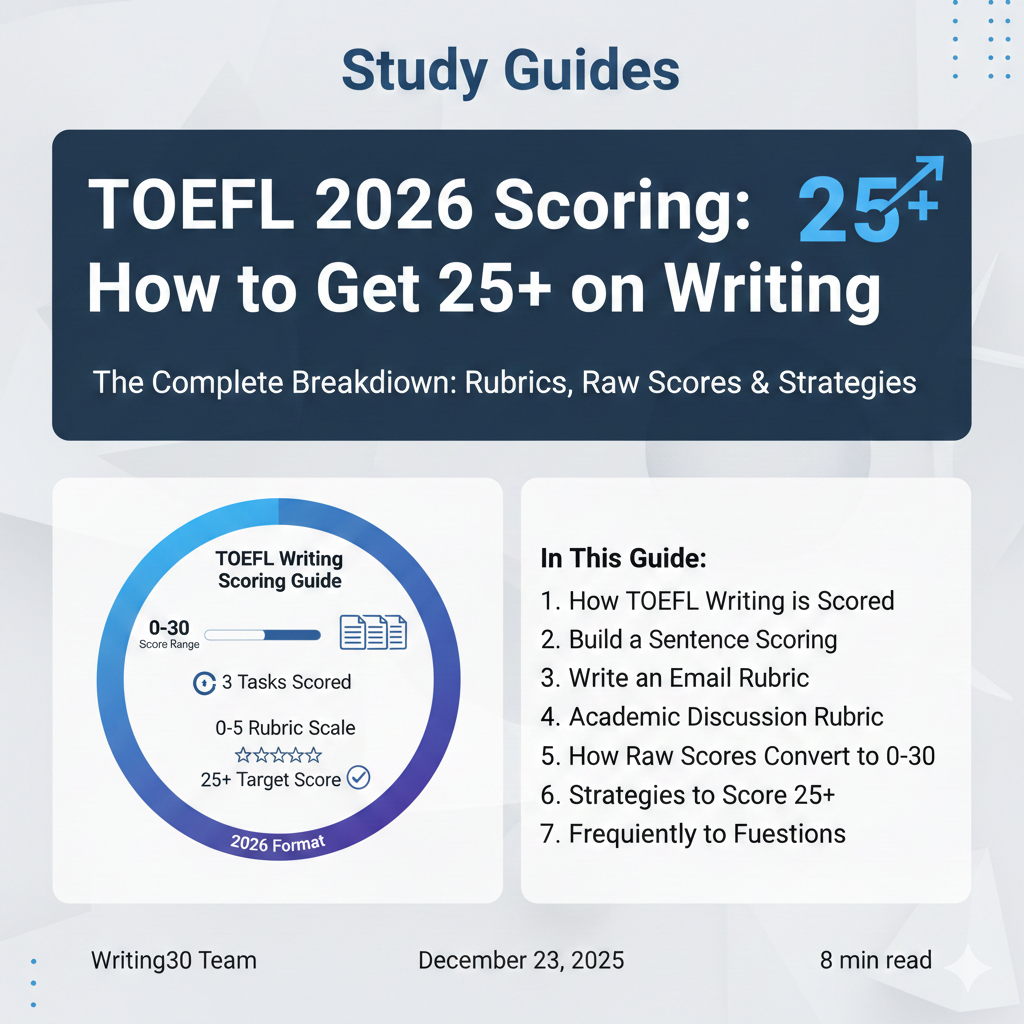
Understanding the official ETS scoring rubrics is essential for maximizing your TOEFL writing score[1]. This guide presents the complete rubrics for both the Write an Email and Academic Discussion tasks[2], along with practical tips for each score level[3]. (See the visual summary infographic at the end for a quick reference.)
Official ETS Writing Rubrics PDF
Download the official scoring rubrics directly from ETS. This document contains the authoritative criteria used by human raters and the e-rater system.
Download Official ETS Rubric PDFWrite an Email Scoring Rubric
The Write an Email task is scored on a 0-5 scale based on how well you complete the communicative goals, use appropriate register/tone, organize your ideas, and demonstrate grammatical control.
The response is a relevant and very clearly expressed contribution that successfully accomplishes all three communicative goals, and it demonstrates consistent facility in the use of language.
A typical response displays the following:
- • Relevant and well-elaborated accomplishment of all three goals and/or details
- • Effective use of a variety of syntactic structures and precise, idiomatic word choice
- • Almost no lexical or grammatical errors other than those expected from a competent writer writing under timed conditions (e.g., common typos or common misspellings or substitutions like there/their)
The response is a relevant contribution that successfully accomplishes all three communicative goals, and facility in the use of language allows the writer's ideas to be easily understood.
A typical response displays the following:
- • Relevant and adequately elaborated accomplishment of all three goals and/or details
- • A variety of syntactic structures and appropriate word choice
- • Few lexical or grammatical errors
The response is a mostly relevant and mostly understandable contribution that addresses all three communicative goals, and there is some facility in the use of language.
A typical response displays the following:
- • Elaboration in which part of an accomplishment of a goal, example or detail may be missing, unclear or irrelevant
- • Some variety in syntactic structures and a range of vocabulary
- • Some noticeable lexical and grammatical errors in sentence structure, word form or use of idiomatic language
The response reflects an attempt to contribute to the email message, but limitations in the use of language may make ideas hard to follow.
A typical response displays the following:
- • Ideas that may be poorly elaborated or only partially relevant
- • A limited range of syntactic structures and vocabulary
- • An accumulation of errors in sentence structure, word forms or use
The response reflects an ineffective attempt to contribute to the email, and limitations in the use of language may prevent the expression of ideas.
A typical response displays the following:
- • Words and phrases that indicate an attempt to address the task, but with few or no coherent ideas
- • Severely limited range of syntactic structures and vocabulary
- • Serious and frequent errors in the use of language
- • Minimal original language; any coherent language is mostly borrowed from the stimulus
The response is blank, rejects the topic, is not in English, is entirely copied from the prompt, is entirely unconnected to the prompt or consists of arbitrary keystrokes.
Academic Discussion Scoring Rubric
The Academic Discussion task is also scored on a 0-5 scale. The key difference from the Email task is the emphasis on contributing to an academic discussion, including engaging with other students' ideas.
The response is a relevant and very clearly expressed contribution to the online discussion, and it demonstrates consistent facility in the use of language.
A typical response displays the following:
- • Relevant and well-elaborated explanations, exemplifications and/or details
- • Effective use of a variety of syntactic structures and precise, idiomatic word choice
- • Almost no lexical or grammatical errors other than those expected from a competent writer writing under timed conditions (e.g., common typos or common misspellings or substitutions like there/their)
The response is a relevant contribution to the online discussion, and facility in the use of language allows the writer's ideas to be easily understood.
A typical response displays the following:
- • Relevant and adequately elaborated explanations, exemplifications and/or details
- • A variety of syntactic structures and appropriate word choice
- • Few lexical or grammatical errors
The response is a mostly relevant and mostly understandable contribution to the online discussion, and there is some facility in the use of language.
A typical response displays the following:
- • Elaboration in which part of an explanation, example or detail may be missing, unclear or irrelevant
- • Some variety in syntactic structures and a range of vocabulary
- • Some noticeable lexical and grammatical errors in sentence structure, word form or use of idiomatic language
The response reflects an attempt to contribute to the online discussion, but limitations in the use of language may make ideas hard to follow.
A typical response displays the following:
- • Ideas that may be poorly elaborated or only partially relevant
- • A limited range of syntactic structures and vocabulary
- • An accumulation of errors in sentence structure, word forms or use
The response reflects an ineffective attempt to contribute to the online discussion, and limitations in the use of language may prevent the expression of ideas.
A typical response displays the following:
- • Words and phrases that indicate an attempt to address the task, but with few or no coherent ideas
- • Severely limited range of syntactic structures and vocabulary
- • Serious and frequent errors in the use of language
- • Minimal original language; any coherent language is mostly borrowed from the stimulus
The response is blank, rejects the topic, is not in English, is entirely copied from the prompt, is entirely unconnected to the prompt or consists of arbitrary keystrokes.
Tips for Each Score Level
To Score 5
- • Address ALL requirements with specific, relevant details
- • Use varied sentence structures (simple, compound, complex)
- • Demonstrate precise vocabulary for the context
- • Proofread for typos - minor errors are acceptable
- • For Discussion: Engage meaningfully with peer responses
To Score 4
- • Address all requirements adequately
- • Use appropriate vocabulary (doesn't need to be advanced)
- • Maintain clear organization throughout
- • Limit grammatical errors to occasional ones
- • For Discussion: Reference at least one peer's point
To Move from 3 to 4
- • Ensure ALL goals/requirements are clearly addressed
- • Develop each point with explanation or example
- • Review for subject-verb agreement and word form
- • Use linking words to improve flow
- • Practice with timed conditions
To Move from 2 to 3
- • Make sure your response is relevant to the prompt
- • Expand vocabulary beyond basic words
- • Focus on key grammar: verb tenses, articles
- • Practice writing complete, clear sentences
- • Hit your length targets so ideas get developed
Official ETS Source
The rubrics presented above are based on the official ETS TOEFL Writing scoring criteria. For the most current and authoritative version, we recommend downloading the official PDF directly from ETS.
Official Resources
Note: ETS may update the rubrics periodically. Always check the official ETS website for the most current scoring criteria, especially if you are preparing for a test in the near future.
Official ETS Writing Rubrics PDF
Download the official scoring rubrics directly from ETS. This document contains the authoritative criteria used by human raters and the e-rater system.
Download Official ETS Rubric PDFFAQ
- How is the TOEFL Write an Email task scored?
- The Write an Email task is scored on a 0-5 scale based on how well you complete the communicative goals, use appropriate register and tone, organize your ideas, and demonstrate grammatical control.
- How is the Academic Discussion task different from Write an Email?
- Academic Discussion is also scored on a 0-5 scale, but it emphasizes contributing to an academic discussion and engaging with other students' ideas instead of writing a professional email.
- What does a score 5 TOEFL writing response look like?
- A score 5 response is relevant and very clearly expressed, includes well-elaborated explanations or details, uses a variety of syntactic structures and precise word choice, and has almost no lexical or grammatical errors beyond small timed-writing slips.
- What gets a score of 0 on TOEFL writing tasks?
- A score of 0 means there is no scorable response. The response may be blank, reject the topic, be written in a language other than English, copy the prompt entirely, be unrelated to the prompt, or consist of arbitrary keystrokes.
Visual Summary: TOEFL Writing Rubrics at a Glance
Save or bookmark this infographic for quick reference when practicing. It summarizes the official ETS scoring criteria for both Write an Email and Academic Discussion tasks.
References & Further Reading
- TOEFL iBT Writing Rubrics — ETS Official PDF (Accessed: December 2025)
- TOEFL iBT Test Content and Structure — ETS Official Website (Accessed: December 2025)
- TOEFL iBT Writing Section — ETS TOEFL Preparation (Accessed: December 2025)
- Understanding TOEFL iBT Scores — ETS Score Users Guide (Accessed: December 2025)
- TOEFL iBT Test Scores and Score Reports — ETS Official Website (Accessed: December 2025)
External links open in a new tab. Writing30 is not affiliated with the linked sources.
Tags
Ready to Improve Your TOEFL Writing?
Get instant AI-powered feedback on your TOEFL writing. Practice with real prompts and see your score improve.
Try Writing30 AI