Unlock 2026 Success: Your Ultimate Guide to Writing Practice for TOEFL
Effective writing practice for TOEFL isn't just about endless drills. It’s about a focused strategy for the three task types you'll face in the 2026 exam format—Build a Sentence, Write an Email, and Academic Discussion—all squeezed into a tight 23-minute window.
We know preparing for this test can feel stressful, but you've come to the right place. We're going to turn that test-day anxiety into high-scoring confidence by breaking down each task into simple, practical strategies you can start using today.
Navigating the 2026 TOEFL Writing Section
The TOEFL Writing section was updated on January 21, 2026. The total time was cut to just 23 minutes, making time management a critical skill. This overhaul introduced three new, focused tasks: 10 Build a Sentence items (about 6 minutes), one Write an Email task (7 minutes), and one Write for an Academic Discussion task (10 minutes).
For a complete rundown of what's new, check out our guide on the full TOEFL 2026 updates.
From Panic to Progress
This guide is all about building practical skills, not just theory. Early data from 2026 test-takers showed that while 68% of students felt an initial panic over the shorter timeline, consistent practice quickly turned things around.
In fact, students who practiced just 10 sessions a week with focused AI feedback tools reported score jumps of up to 2 points on the 1-6 raw score scale within a month. You can find more on these TOEFL writing practice trends on Magoosh.com.
The goal is to move from simply doing exercises to mastering the specific skills each task demands. Consistent, focused practice is the only way to conquer the condensed 23-minute format.
Think of this as your personal coaching session. We'll show you exactly what to do, how to manage your time, and what ETS graders are really looking for. We’re here to help you build the muscle memory you need to hit your target score.
Ready to change your approach? Let's dive into the first task. Your journey to a higher score starts now, and you can get started with a free practice session at Writing30.com.
Mastering the Build a Sentence Task for Speed and Precision
The “Build a Sentence” task is a rapid-fire test of your grammatical intuition. In the 2026 TOEFL format, you'll face 10 of these questions back-to-back, with only about 30-40 seconds to solve each one. Getting these right isn't about luck—it's about training your brain to see sentence patterns in a flash.
This task directly tests your ability to recognize correct English sentence structure. A high score (achieved by getting most or all 10 correct) shows you can quickly assemble grammatically sound sentences. Let’s build a system for speed and precision.
The Scan and Anchor Method
Your first instinct might be to start moving words immediately. Resist that urge. Take one or two seconds to scan for the grammatical “anchors” of the sentence.
- Subject: Who or what is doing the action?
- Verb: What is the action?
- Object: What is receiving the action?
Once you find these core components, the rest of the sentence—like prepositional phrases or clauses—falls into place much more easily.
Actionable Tip: Let's try an example. You're given these scrambled words:
volcanic eruptions / can have / on the global climate / a significant impact
Instead of guessing, find your anchors:
- Subject:
volcanic eruptions - Verb Phrase:
can have - Object:
a significant impact
The remaining phrase, on the global climate, clearly describes the impact. Just like that, the sentence snaps together: Volcanic eruptions can have a significant impact on the global climate. This method turns a confusing puzzle into a simple assembly process. To get this down under pressure, check out our detailed guide on specific strategies for the Build a Sentence task.
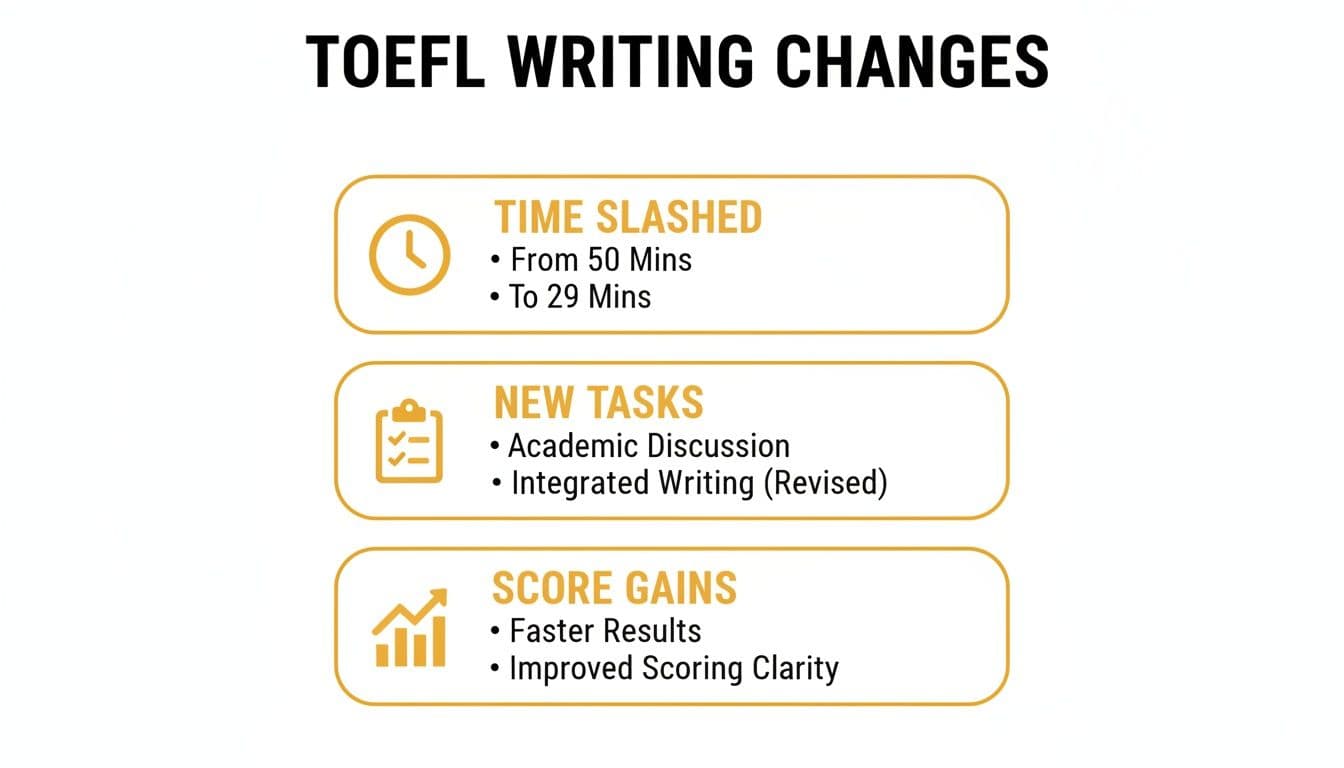
This infographic gives you a quick visual summary of the key changes to the TOEFL Writing section, highlighting why new, faster tasks like Build a Sentence are so important now.

As you can see, it's not just about the new tasks and slashed time. The infographic also points to the potential for big score gains, proving that targeted practice leads to real, measurable improvement.
Avoiding Common Traps
The test makers love to include distractors designed to throw you off. Keep an eye out for these common pitfalls:
- Misplaced Modifiers: A descriptive phrase is in the wrong spot, making the sentence sound awkward.
- Subordinate Clause Errors: The sentence starts with a word like "although" or "because," but the main clause is structured incorrectly.
- Incorrect Word Order: Adjectives, adverbs, and prepositional phrases are often the trickiest pieces to place correctly.
The key to scoring high on this task is developing grammatical muscle memory. Consistent, timed TOEFL writing practice is the only way to make your recognition of correct structures automatic.
Simulating this high-pressure environment is critical. Using a practice tool that mimics the real exam, like the drills on Writing30, trains your brain for speed. When you can bank time on these 10 quick questions, you reserve precious mental energy for the tougher email and discussion tasks that come next.
How to Craft a Perfect Email in Under 7 Minutes

The "Write an Email" task on the 2026 TOEFL isn't just a grammar quiz. It's a test of how well you can handle real-world academic communication under a strict 7-minute timer. To get a high score (in the 5-6 raw score band), you need to prove you can quickly figure out your goal, your audience, and the right tone.
The scenarios are practical things you'll actually do as a student, like emailing a professor for an extension or coordinating a project with classmates. Every prompt gives you a clear objective, and if you miss any part of it, you will lose points.
Deconstructing the Prompt in Seconds
Before you even think about writing, take the first 15-20 seconds to break down the prompt. Resist the urge to start typing right away. Instead, pinpoint these three things:
- Your Goal: What’s the main reason for the email? Are you asking for help, apologizing, or trying to schedule a meeting?
- Your Audience: Who is this email for? Writing to a professor demands a formal tone, but an email to a classmate can be more casual.
- The Requirements: Does the prompt ask you to include specific details or ask certain questions? You have to hit every single point.
Getting the tone wrong is one of the biggest and most common mistakes. Sending an email to "Professor Smith" that starts with "Hey!" is an immediate red flag. It shows you don't understand the context, and your score will suffer, even if your grammar is flawless.
High-Scoring Sample and Breakdown
Actionable Tip: Let’s walk through a common scenario. Imagine you need to email your classmate, Sarah, to ask about a lecture you missed and propose a time to meet.
Low-Scoring Response (Too Informal/Vague):
Hey Sarah, I missed class. What happened? Can we meet? Thanks, [Your Name]
This version is too short and doesn't sound polite. It's vague and doesn't fully accomplish the task's goals.
High-Scoring Response (Clear, Polite, and Complete):
Hi Sarah,
Hope you're having a good week.
I'm writing because I was unfortunately unable to attend Professor Miller's lecture on cognitive psychology yesterday. I was hoping you could briefly share what the main topics were and if there were any important announcements.
I'd also love to review the notes if you have a moment. Would you be free to meet for about 15 minutes sometime tomorrow afternoon?
Thanks so much for your help!
Best, [Your Name]
See the difference? This response works because it's polite, it gets straight to the point, and it suggests a specific action ("meet for about 15 minutes tomorrow afternoon"). This is exactly the kind of detail and tone that earns a top score. For more examples, check out our complete guide to TOEFL email writing.
A top-scoring email directly addresses all parts of the prompt, uses a tone appropriate for the recipient, and makes a clear request or provides specific information. It shows you can communicate effectively, not just write English sentences.
To really level up your writing practice for TOEFL, try using a tool like Writing30. It gives you instant feedback on your email's tone, task completion, and grammar. This helps you catch and fix mistakes before test day, so you're ready to nail that email in under seven minutes.
Dominating the Academic Discussion Task

The "Academic Discussion" task is a 10-minute sprint. You’ll read a short post from a professor and two other students, then write your own contribution of at least 100 words. The clock is ticking, but a solid strategy is all you need to perform well every time.
Your job isn't just to drop your opinion. It’s to add to the conversation. This means your response must be well-supported and connect directly to what your "classmates" have already said. The best posts are analytical, use strong academic English, and move the discussion forward.
The Anatomy of a High-Scoring Post
Want to land in the top score range of 5-6? Your post needs a clear, logical structure. Think of it as a mini-argument with three essential parts.
- State Your Position: Get straight to the point. Do you agree with the professor? With one of the students? Or do you have a different take? Be decisive.
- Provide Support: This is what separates a great response from an average one. You must back up your position with a specific reason, a brief personal example, or a logical point.
- Contribute to the Discussion: Explicitly connect your idea back to the conversation. Try phrases like, "Building on what Maria said..." or "While I see John's point about X, I believe Y is a bigger factor because..."
Actionable Tip: Here’s a sample response structure you can practice with.
Prompt: The professor asks if technology in the classroom is more of a distraction than a benefit. Student A agrees it's a distraction. Student B says it's a benefit.
Your Response (Sample Structure):
(State Position) While I understand John’s concern about distraction, I agree with Maria that technology is a powerful educational tool.
(Provide Support) In my own experience, using interactive simulations in a biology class helped me understand complex processes much better than a textbook could. When used with a clear purpose, technology makes learning more engaging.
(Contribute to Discussion) The key, as the professor's question implies, is how it's integrated. Perhaps the real discussion should be about establishing guidelines for technology use, rather than banning it.
Mastering how to respectfully disagree or build on someone's idea is a game-changer. For a deeper dive into this, check out our guide on how to use counterclaims and rebuttals effectively.
From Simple Words to Academic Language
One of the fastest ways to level up your response is to upgrade your vocabulary. Using precise, academic language signals to scorers that you're ready for university-level work. Consistent writing practice for TOEFL makes these words feel natural.
For example, don't just say this:
- Simple: "I think technology is good for learning."
Instead, aim for something like this:
- Academic: "The integration of technology into the curriculum can significantly augment student engagement and learning outcomes."
Pro Tip: Your post must make a clear, well-supported contribution to the online class discussion. You have to state and develop an opinion, making a relevant and thoughtful point that pushes the conversation forward.
The only way to get comfortable with this task is to practice with a wide range of prompts. The diverse prompts on Writing30.com are perfect for this kind of drill. You get instant, rubric-aligned feedback on your argument’s coherence, development, and vocabulary, which helps you zero in on your weak spots.
Using AI Feedback to Sharpen Your Writing Skills
Good practice is essential. But smart, targeted practice is what really moves the needle on your TOEFL score. Using AI feedback from a platform like Writing30.com is the fastest way to turn generic drills into a focused plan for fixing your specific weaknesses.
It’s time to look past the estimated score. Real improvement comes from digging into the feedback to find your personal error patterns—whether it's a nagging subject-verb agreement issue, repetitive vocabulary, or an awkward sentence structure you don't even realize you're using.
From Feedback to a Higher Score
This is how you turn feedback into points. One student I worked with was stuck at a score of 4 on the Academic Discussion task. Their ideas were solid, but the AI feedback consistently flagged "undeveloped ideas" because they never included specific examples.
Actionable Tip: They started a new habit. For every practice post, they made sure to add a concrete personal example or a specific piece of evidence. Within two weeks, their score jumped into the 5-6 band. You can do the same.
This is the core of effective writing practice for TOEFL. It's like having a personal tutor who's available 24/7 to point out exactly what you need to fix.
How to Read Your AI Score Report
The AI grading for the TOEFL writing section is tough. For the Write an Email task, 41% of responses are penalized simply for using the wrong level of formality. In the Academic Discussion task, top scorers (in the 5-6 raw score band) masterfully weave peer points into their own arguments, while many test-takers lose points for poor coherence. You can discover more about these scoring insights and how to fix them.
AI tools like Writing30.com are designed to solve these exact problems. They give you an estimated score in seconds, plus personalized mistake cards that show you what went wrong.
When you get your feedback, zero in on these areas:
- Task Fulfillment: Did you answer every part of the prompt? For the email, did you address the purpose and audience correctly? For the discussion, did you contribute a new idea while engaging with peers?
- Coherence and Cohesion: Does it flow? AI is great at suggesting transition words to connect your sentences more smoothly.
- Vocabulary and Word Choice: Are you stuck using the same basic words? Look for synonym suggestions to build your academic vocabulary.
- Grammar and Mechanics: Find your recurring errors. Is it always articles? Prepositions? This becomes your personal grammar checklist to review before every practice.
Think of AI feedback as a diagnostic tool. It empowers you to stop practicing blindly and start improving with every single response you write.
Ready to see how personalized feedback can change your score? Try a few practice tasks for free on Writing30.com and get your instant writing analysis.
Your Actionable Weekly TOEFL Writing Practice Plan
Feeling overwhelmed by your TOEFL writing practice? I get it. The key to hitting your target score isn't just about practicing more—it's about practicing smarter. This weekly schedule will give your prep structure, turning random drills into a focused, skill-building routine.
Think of this as a flexible roadmap. Adjust the days and times to fit your life. The core principle is a balanced mix of focused practice, timed drills, and honest review.
Structuring Your Practice Week
Consistency is your biggest asset. Carving out small, dedicated blocks of time each day is far more effective than cramming one long session into your weekend. This builds the muscle memory you need for all three writing tasks.
Actionable Tip: Here's a sample schedule you can adapt:
- Monday & Thursday (Skill Focus): Dedicate 15-20 minutes to a single task type. On Monday, do only "Build a Sentence" drills on a platform like Writing30.com. On Thursday, focus exclusively on the "Academic Discussion" task, trying different prompts.
- Tuesday & Friday (Timed Simulation): Spend 25-30 minutes simulating the entire writing section. Do 10 "Build a Sentence" questions (aim for 6 mins), one "Write an Email" task (7 mins), and one "Academic Discussion" post (10 mins). Use a strict timer for every single task.
- Wednesday (Review & Rewrite): This is where the real learning happens. Spend 20 minutes digging into the AI feedback on your lowest-scoring responses. Don't just read it—rewrite one full email or discussion post using the specific suggestions you received.
Making Your Practice Realistic
To make your writing practice for TOEFL count, you must mimic real test conditions as closely as possible. This is how you train yourself to perform when the pressure is on.
The goal of practice isn't just to get the answers right. It's to build the mental stamina and automaticity you need to perform flawlessly when the clock is ticking and your score is on the line.
Here’s how to create that authentic test environment:
- Use a Timer for Everything. This is non-negotiable.
- Eliminate Distractions. Turn off your phone notifications. Close other browser tabs.
- Don't Use Outside Help. No spell-check, no grammar tools, no dictionaries. You won't have them on test day, so don't get used to them during practice.
By building these habits, you're not just practicing writing; you're rehearsing for test day itself. This preparation can make a massive difference, especially when paired with quality study materials. For more resources, check out our guide on finding quality TOEFL practice tests to add to your training.
This structured weekly plan removes the guesswork and helps you build skills methodically. You’ll know exactly what to work on each day, making every minute of your study time push you closer to your goal score.
You have the tools and the plan. Now it's time to take action and build the confidence you need for test day. Start with a free practice session on Writing30 and get instant, rubric-aligned feedback on your writing today. Visit https://writing30.com to begin.
Ready to Practice?
Try all 3 TOEFL 2026 writing tasks with instant AI feedback.
Tags
Ready to Improve Your TOEFL Writing?
Get instant AI-powered feedback on your TOEFL writing. Practice with real prompts and see your score improve.
Try Writing30 AI