What does a declarative sentence mean? Tips to boost your TOEFL score in 2026
Feeling anxious about all the grammar rules you need for the TOEFL? Don't worry, you're not alone. Let's focus on the single most important sentence type you'll use: the declarative sentence.
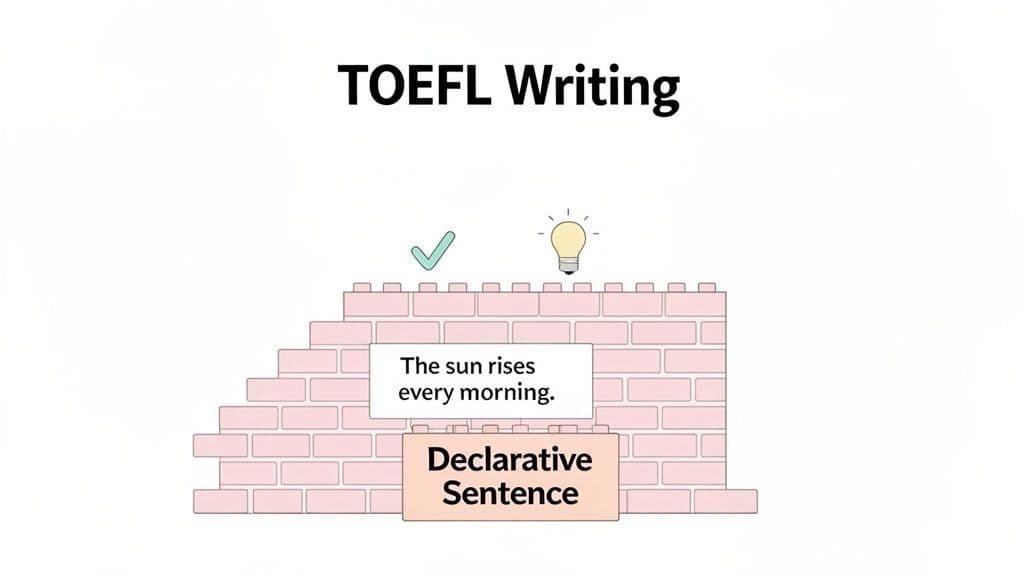
Put simply, a declarative sentence makes a statement, states a fact, or shares an opinion. It’s the foundational brick you'll use to build every single one of your TOEFL writing responses. Understanding it is your first step toward confidence.
What a Declarative Sentence Means for Your TOEFL Score

When you’re preparing for the TOEFL, it's easy to feel overwhelmed by complex grammar. But at its core, a high score comes down to communicating clearly, and the declarative sentence is your number one tool for the job.
These simple "statement" sentences are the backbone of your writing for all three TOEFL 2026 tasks:
- Build a Sentence: You'll arrange scrambled words to form a perfect declarative sentence. This task directly tests your grasp of sentence structure.
- Write an Email: You'll state your purpose and give information using clear, direct declarative sentences to show you can handle professional communication.
- Academic Discussion: You'll present your main arguments and support them with strong, factual statements to contribute meaningfully to the conversation.
Mastering declarative sentences is the first step toward writing with confidence and achieving a high score. They are the building blocks for every well-organized response. The key is using them correctly and effectively, a skill you can sharpen with targeted practice. For instance, our guide to Build a Sentence strategies shows exactly how this applies.
Before we dig into examples and common mistakes, let's lock in the basics with this quick overview.
Declarative Sentences on the TOEFL at a Glance
Here’s a quick reference table that breaks down the key features of a declarative sentence. Keep this in mind as you practice.
| Feature | Description |
|---|---|
| Purpose | To make a statement, state a fact, provide information, or share an opinion. |
| Punctuation | Always ends with a period (.). |
| Structure | Typically follows a Subject-Verb-Object pattern (e.g., "The university offers..."). |
| Example | The professor’s lecture explained the main causes of climate change. |
Think of this as your cheat sheet. As long as you remember these core rules, you're on the right track to building strong, clear responses.
Why Declarative Sentences Are the Backbone of High-Scoring Answers
On the TOEFL, clear communication is everything. Declarative sentences are your best tool for making the strong, direct statements that ETS graders want to see. They are the bedrock of the clear academic and professional writing you need to demonstrate.
But here’s the thing: just using them won't guarantee a top score. The TOEFL isn’t just about being correct; it’s about showing proficiency. If all your sentences are basic declarative statements, your writing will seem too simple, signaling a limited command of English and likely resulting in a score in the 20-23 range.
The Balance Between Clarity and Variety
The secret to a higher score (24-30 range) is to balance the solid clarity of declarative sentences with more complex structures. This shows grammatical range and sophistication—two things that heavily impact your final score according to the official ETS rubric. In the Academic Discussion task, for example, you might start with a simple declarative sentence to state your point, then follow it up with more complex sentences that add detail and nuance.
A well-crafted response uses declarative sentences as the starting point, not the final destination. Graders want to see that you can build upon these foundational statements with varied and complex structures to fully develop your ideas.
This balance is absolutely critical. While declarative sentences are reliable, relying on them too heavily is a major pitfall. You can learn more about how this ties into the official rubrics in our detailed guide to TOEFL writing scoring.
How This Affects Your TOEFL Score
Under the 2026 format, your writing is measured against specific rubric criteria, where "Facility with Language" (grammar and sentence variety) is a key component. Research shows English learners have a low error rate with declarative sentences, but how you use them is what really matters.
ETS rubrics award a significant portion of your score for grammatical accuracy and sentence variety. Over-reliance on simple declarative sentences can lead to a lower score in "Linguistic Features" and "Development" because your ideas may appear underdeveloped.
The takeaway is clear: mastering the declarative sentence is your first step. The next, and most important, is learning to mix it with other sentence types to create the dynamic, impressive responses that earn top marks on test day.
See How Declarative Sentences Work in Each TOEFL Task
Theory is a great start, but seeing declarative sentences in action is what really prepares you for test day. Let's break down how these fundamental sentences function in each of the three TOEFL Writing tasks, effective January 21, 2026.
You'll see exactly how small adjustments can elevate your answers and boost your score.

As the map shows, a strong command of declarative sentences directly boosts your clarity, improves your sentence variety, and has a real impact on your final score.
Task 1: Build a Sentence
In this task, you get a set of scrambled words and have to build a perfect declarative sentence. It’s a direct test of your grasp of English word order. Get one word wrong, and you get zero points. It's a high-pressure task, but very manageable with practice.
- Prompt: study / are becoming / the recent / sources / according to / cost-effective / renewable energy / increasingly
- Sample Response: According to the recent study, renewable energy sources are becoming increasingly cost-effective.
Actionable Tip: Don't just drag and drop randomly. First, identify the subject ("renewable energy sources") and the verb ("are becoming"). Then, build the rest of the sentence around that core. Practicing this strategy will make you faster and more accurate. You can practice hundreds of these on our platform by reviewing free Build a Sentence samples.
Task 2: Write an Email
Here, the goal is clear and professional communication. Your declarative sentences are your primary tool for stating your purpose, asking for information, or explaining a problem. You have 10 minutes to write at least 100 words.
A strong email gets straight to the point. Your opening should be a declarative sentence that immediately tells the reader why you are writing. This shows respect for their time.
- Prompt: You missed a class due to illness and need to ask your professor for the lecture notes.
- Sample Response: Dear Professor Smith, I am writing to respectfully request the lecture notes from Monday's class, which I missed due to an unexpected illness. I have already reviewed the syllabus and course materials online, and I would be very grateful for any additional information you could provide to help me catch up. Thank you for your understanding.
Actionable Tip: Always start with a clear statement of purpose. Notice how the sample response is direct, polite, and provides context. Practice writing emails for common scenarios (asking for an extension, clarifying a concept, etc.) to build confidence.
Task 3: Academic Discussion
For this final task, you have 10 minutes to write a meaningful post (at least 100 words) for an online class discussion. You need strong declarative sentences to state your argument with clarity and confidence. Weak or vague statements get low scores.
- Prompt: Your professor claims online learning is more effective than traditional learning. State your opinion and support it.
- Sample Response: I agree with the professor’s point because online learning offers significant flexibility, which allows students to balance their studies with work commitments. For example, my friend is able to work full-time while pursuing her degree online, an opportunity she would not have in a traditional classroom setting. This flexibility directly contributes to student success and accessibility in higher education.
Actionable Tip: Don't just say "I agree." Start with a strong declarative statement of your position, then immediately follow it with a supporting reason or example, as shown in the sample. This "Claim + Evidence" structure is highly effective.
Fix Common Declarative Sentence Mistakes Before Test Day
It’s completely normal to make mistakes under pressure. But when it comes to declarative sentences, the most common errors are surprisingly easy to fix once you know what to look for. You can do this!
Let's break down the exact issues that trip up test-takers so you can sidestep them on exam day.

Even advanced learners can slip up on basic grammar rules when the clock is ticking. This isn't just a beginner problem. These small mistakes can quickly add up and hurt your score. Let's make sure that doesn't happen to you.
Pinpoint and Correct These Common Errors
Most errors fall into three buckets: subject-verb agreement, awkward word order, and inconsistent tense. Getting these wrong can make your writing sound confusing and will definitely lower your score on the TOEFL writing tasks.
Subject-Verb Agreement: The subject and verb have to match. Simple as that.
- Mistake: The professor she explain the concept.
- Correction: The professor explains the concept.
Awkward Word Order (SVO): English almost always follows a Subject-Verb-Object pattern. Sticking to it makes your writing clear.
- Mistake: Always my friend studies in the library.
- Correction: My friend always studies in the library.
Inconsistent Verb Tense: Don’t jump between past and present unless there's a good reason.
- Mistake: He walked to class and then sees his friend.
- Correction: He walked to class and then saw his friend.
Think these are just minor issues? One study found the average grammar score was only 73.13 out of 100, showing there's a lot of room for improvement, even on these "simple" statements. If you're curious, you can check out the full research findings on student grammar performance to see just how critical practice is.
The fastest way to iron out these wrinkles is with targeted practice and feedback. Using a tool like Writing30.com is a game-changer because its AI gives you instant feedback on these exact mistakes. It helps you build stronger writing habits long before you sit down for the actual test.
How to Elevate Your Sentences for a Top Score
Ready to go from a good score to a great one? Knowing what a declarative sentence is gets you in the door. But showing you can use them with sophistication is what earns top marks. You have the ability to do this.
To really impress the ETS graders, you need to turn your simple statements into more complex and varied sentences. It’s not about using big, fancy words. It’s about proving you have total control over English sentence structure.
The trick is to combine simple sentences into more powerful ones using conjunctions (like and, but, so) and subordinate clauses that start with words like because, although, or while.
From Simple to Sophisticated
Sentence variety is a massive indicator of your English skill on the TOEFL. If all your sentences sound the same—starting with "The professor said..." or "I think that..."—your writing will feel flat and basic. You need to show you can build more complex ideas.
- Simple: The university built a new library. It has more resources for students. (Score range: 20-23)
- Better (Compound): The university built a new library, and it has more resources for students. (Score range: 22-25)
- Best (Complex): Because the university built a new library, students now have access to more resources. (Score range: 26-30)
See how that "Best" example clearly explains a cause-and-effect relationship? That level of precision is exactly what scorers look for in a high-scoring Academic Discussion response.
Top-scoring writers don't just state facts; they connect them. They use varied sentence structures to build a logical and persuasive argument, which is a key criterion in the official TOEFL rubric.
This isn't just a nice skill to have—it's directly tied to your score. Research shows that sentence complexity is a hallmark of language proficiency. You can explore the research on sentence development here if you want to dive deeper.
Actionable Tip: After writing a practice response, reread it specifically for sentence structure. Find two simple sentences next to each other and try to combine them using words like "although," "since," or "which." This simple exercise will dramatically improve your sentence variety. The AI feedback at Writing30.com helps you spot exactly where your sentences are too simple, making this process even easier.
Common Questions About Declarative Sentences on the TOEFL
When you're preparing for the TOEFL, it's natural to have questions. Let's walk through the most common ones test-takers have about declarative sentences. Getting these answers straight will build your confidence for test day.
Mastering the basics is the first step toward a high score. Knowing exactly how, when, and why to use these fundamental sentences is a huge advantage.
Can I Get a High Score with Only Simple Declarative Sentences?
No. While declarative sentences are the foundation, relying on them alone will keep you from a high score (24+). The ETS graders are specifically looking for sentence variety in your responses.
Think of simple statements as your starting point. To demonstrate advanced grammatical skill, you must mix in complex and compound sentences. The goal isn't just to be understood—it's to show sophistication. Using a practice tool like the one at Writing30.com is a great way to see if your sentences are getting repetitive and get suggestions to vary your structures.
What Is the Biggest Mistake Students Make?
The two most frequent errors are subject-verb agreement and run-on sentences. Errors like “The students writes…” instead of “The students write…” immediately signal a lack of control to the graders.
Similarly, smashing two complete thoughts together without the right punctuation is a major red flag. These mistakes might seem small, but they can significantly pull your score down into a lower band.
Don’t let basic errors cost you a top score. The best way to fix these habits is through consistent practice with instant, targeted feedback before you sit for the real exam.
How Can I Practice Building Better Sentences for the TOEFL?
The most effective way is to practice with the actual 2026 TOEFL tasks.
- For the Build a Sentence task, use a timer and drill for speed and accuracy. Focus on identifying the subject-verb pair first.
- For the Write an Email and Academic Discussion tasks, write full responses. Then, go back and review them only for sentence structure. Challenge yourself to combine at least two simple sentences into one complex sentence in each response.
This kind of focused practice is the fastest path to improvement. A platform that offers immediate, rubric-aligned feedback on your grammar and sentence variety, like our free tools, is the most efficient way to build the right skills for a high score.
Ready to turn these tips into a higher score? Stop feeling anxious and start improving with Writing30. Get instant, AI-powered feedback on your grammar, sentence variety, and overall writing quality for every TOEFL task. Try our free practice questions and see your estimated score today at https://writing30.com. You can do this
Ready to Practice?
Try all 3 TOEFL 2026 writing tasks with instant AI feedback.
Tags
Ready to Improve Your TOEFL Writing?
Get instant AI-powered feedback on your TOEFL writing. Practice with real prompts and see your score improve.
Try Writing30 AI