7 Best Vocabulary for TOEFL Resources for the 2026 Exam
Facing the TOEFL in 2026? A strong vocabulary for TOEFL is not just about memorizing endless lists of words. We know preparing for this exam can be stressful, but building your vocabulary is a manageable—and even rewarding—process. It's about understanding the right words and using them effectively under pressure, especially in the writing section. Many test-takers worry that their vocabulary isn't 'academic' enough, a common source of anxiety for the three writing tasks: Build a Sentence, Write an Email, and Academic Discussion.
Let's clear up a common myth: to achieve a top score (25-30) in the writing section, you don't need obscure or overly complex words. Instead, the goal is to master high-frequency academic vocabulary and apply it with precision and context. This is what separates a good score from a great one.
This guide is designed to give you specific, actionable strategies. We will explore a curated selection of the best resources available and, more importantly, show you exactly how to apply these words in sample responses for each writing task. You’ll get practical tips you can use immediately to write with more clarity, sophistication, and confidence.
We've researched the best platforms for you, providing direct links and clear descriptions. You'll learn not just what words to learn, but how to integrate them into your responses to meet the official ETS scoring criteria. For instance, we'll demonstrate how you can practice using new vocabulary in an Academic Discussion post and get immediate feedback on your usage with tools like writing30.com. Let's transform your vocabulary from a source of stress into your greatest asset on test day.
1. Writing30 AI
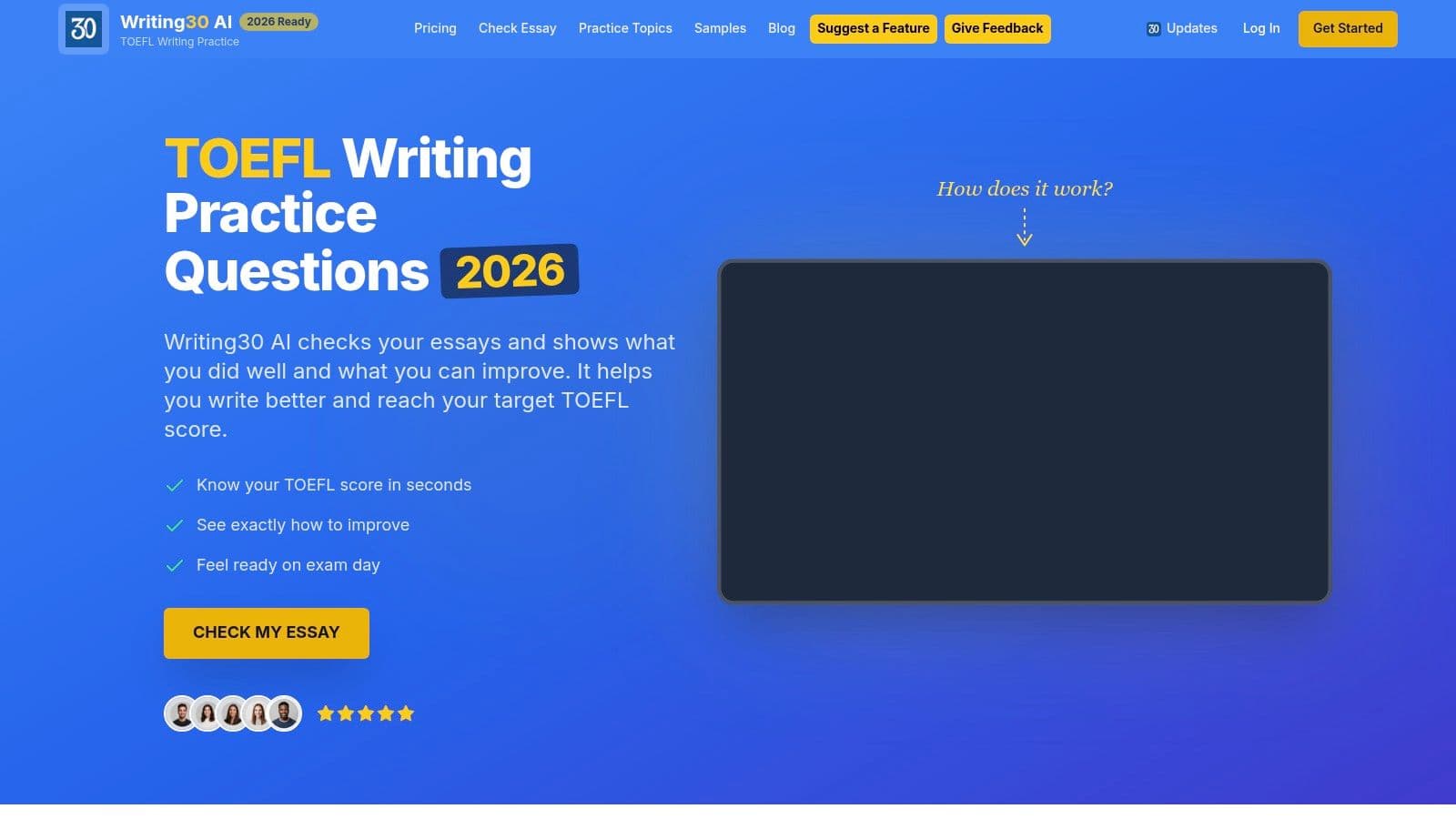
Writing30 AI presents a powerful, targeted approach to mastering TOEFL vocabulary by embedding it directly into the context where it matters most: your writing. While many resources offer static word lists, Writing30 AI’s strength lies in its dynamic, feedback-driven system that helps you actively use and refine your word choices. This platform is built specifically for the 2026 TOEFL format, ensuring your practice is always relevant to the current exam, including the Build a Sentence, Write an Email, and Academic Discussion tasks.

The platform’s core function is its instant, rubric-aligned scoring. When you submit a response, the AI analyzes it in seconds, providing a score estimate and detailed feedback. For vocabulary improvement, this is a game-changer. The system flags repetitive or basic words and suggests stronger, more academic synonyms. This immediate correction loop helps you move from passively memorizing words to actively applying them under pressure, which is crucial for a high score.
How Writing30 AI Builds Your Vocabulary
Writing30 AI integrates vocabulary learning directly into your exam preparation. It’s not just about learning words in isolation; it’s about using them effectively to construct high-scoring arguments.
- Contextual Suggestions: Instead of just telling you a word is "weak," the feedback provides specific, academic alternatives that fit the context of your sentence. If you repeatedly use "good," the system might suggest "beneficial," "advantageous," or "constructive," depending on the topic.
- Actionable Tip: Practice using these suggestions immediately. For the Write an Email task, if the AI suggests replacing "important" with "crucial," try it. For example, change "It is important to meet the deadline" to "It is crucial that we meet the deadline to ensure the project's success." This small change adds formality and precision.
- Repetitive Word Detection: A common pitfall for test-takers is word repetition, which signals a limited vocabulary to ETS graders. The platform's analysis highlights these patterns, making you aware of your verbal habits and pushing you to diversify your language.
- Practical Example (Academic Discussion):
- Weak vocabulary: "The professor makes a good point. It's good that the new policy will help students. But it has bad sides too."
- Strong vocabulary: "The professor presents a compelling argument. While the new policy offers significant benefits for students, we must also consider its potential drawbacks."
- This simple upgrade demonstrates a stronger command of academic language, which can help you score in the 4-5 range on the rubric.
Why It Stands Out
What distinguishes Writing30 AI is its focus on active application. Passive learning, like reviewing flashcards, has its limits. Writing30 AI forces you to produce language under timed conditions, mimicking the real test environment. The unlimited submissions model allows for intensive practice; you can write, get feedback, revise, and resubmit until you've mastered the vocabulary for a specific task. This iterative process is one of the fastest ways to build writing fluency and confidence.
The platform's transparent pricing offers flexibility. A two-week plan at $11.89 is perfect for last-minute, concentrated practice. For more structured preparation, the three-month plan at $29.89 provides the best value. Both plans grant unlimited access to all features, including full mock tests.
While it lacks a free trial for the paid features, its focused toolset and strong user testimonials (with many students reporting scores of 28+) make it a compelling choice for serious test-takers. You can, however, try free practice tasks on the homepage.
Website: https://writing30.com
2. Magoosh TOEFL Vocabulary Flashcards
For TOEFL test-takers who prefer a focused, high-yield approach, Magoosh offers a powerful and free resource. Their TOEFL Vocabulary Flashcards are built around a curated list of 600 essential words. This platform is perfect for learners who feel overwhelmed by massive word lists and want a clear, manageable goal.
The strength of Magoosh lies in its simplicity and direct application to the exam. The 600 words were carefully selected by TOEFL experts for their high frequency in academic contexts, making them prime candidates for both your reading comprehension and your written responses in the 2026 TOEFL format.

Key Features and User Experience
Magoosh’s system is designed for efficient, daily study sessions. It operates on both web and native mobile apps (iOS/Android), with seamless progress syncing. This allows you to review words during a short break or while commuting.
The platform uses a spaced-repetition algorithm. This smart system tracks your performance, showing you difficult words more often and familiar words less frequently, optimizing your study time. Each flashcard provides a concise definition and a clear example sentence, giving you immediate context.
Pricing and Access
The Magoosh TOEFL Vocabulary Flashcards are completely free. You can start studying immediately on their website without even needing an account. This accessibility makes it an excellent starting point for any student building their vocabulary for TOEFL.
How to Use Magoosh for TOEFL Writing
To get the most out of this tool, you must integrate the words directly into your writing practice. This is how you move from passive knowledge to an active skill.
- Daily Review: Spend 15-20 minutes with the flashcards each day.
- Select Target Words: From your daily review, pick 3-5 new words to actively use. For instance, you might learn "stipulate," "subsequent," and "ambiguous."
- Practice with writing30.com:
- Build a Sentence: Task: Use "ambiguous" and "clarification" to build a sentence. Sample Response: "Because the instructions were ambiguous, the students requested clarification from the professor."
- Write an Email: In a practice email prompt, try to naturally include a word like "stipulate." Sample Response: "Dear Professor Smith, The syllabus seems to stipulate that all essays must be submitted by midnight, but the online portal shows a different deadline. Could you please clarify?"
- Academic Discussion: Incorporate a word like "subsequent" into your post. Sample Response: "The professor's initial point about urban planning was clear, but her subsequent examples about gentrification seemed to contradict her main argument."
- Get Feedback: Submitting your responses to an AI tool like Writing30 helps you check for correct usage and receive suggestions for improvement.
This active recall and application method is far more effective than passive memorization.
Final Takeaway: Magoosh provides a focused, free, and efficient path to learning 600 of the most important TOEFL words. Its spaced-repetition system and mobile access make it a fantastic tool for consistent, on-the-go study.
Website: Magoosh TOEFL Vocabulary Flashcards
3. Barron’s “TOEFL Essential Words” (book / eBook)
For students who thrive with a structured, book-based approach, Barron’s “TOEFL Essential Words” is a classic and highly respected resource. This title offers a methodical path to mastering key vocabulary through a curated collection of approximately 500 words, organized into thematic chapters. It’s an ideal choice for disciplined learners who prefer the focused, offline experience of a book.
The value of Barron’s lies in its direct, exam-focused curation from a trusted test-prep publisher. The words are presented within themes like nature, business, and social science, which mirror the academic topics you'll encounter on the TOEFL. This thematic organization helps build mental connections between words, making them easier to recall and use in context.

Key Features and User Experience
Barron's provides a more traditional study experience. Each chapter introduces a set of words with definitions, parts of speech, and example sentences. Crucially, the book follows up with practice exercises designed to reinforce your understanding. These exercises are great for confirming your comprehension before you try to use the words in your own writing.
The latest edition is available as both a physical book and an eBook, which includes audio support to help with pronunciation. While it lacks the smart algorithms of digital apps, its clear, chapter-by-chapter format is perfect for creating a predictable daily study routine.
Pricing and Access
The eBook version of Barron’s “TOEFL Essential Words” is very affordable, typically under $20 on platforms like Simon & Schuster. This low-cost, one-time purchase gives you permanent access to a high-quality study guide. This makes it a reliable part of building your vocabulary for TOEFL.
How to Use Barron's for TOEFL Writing
To make this book an active tool for the 2026 TOEFL format, you must bring the words off the page and into your practice. Don't just read—write!
- Study a Chapter: Complete one of the thematic chapters, focusing on understanding the words in their given contexts.
- Choose Target Words: Select 3-4 words from the chapter. For example, from a chapter on technology, you might learn "devise," "innovative," and "component."
- Practice with writing30.com:
- Build a Sentence: Task: Use "innovative" and "devise" to build a sentence. Sample Response: "The engineers were tasked to devise an innovative solution to reduce energy consumption."
- Write an Email: In a practice email, use a word like "component" to clarify a need. Sample Response: "Dear Team, A crucial component of our presentation is missing—the market analysis data. Can someone please provide it by 3 PM today?"
- Academic Discussion: Incorporate "innovative" into your post. Sample Response: "I agree with Sarah that the proposed solution is innovative. However, its reliance on untested technology might make it too risky to implement on a large scale."
- Check Your Usage: Submit your writing to an AI platform for immediate feedback on whether you used the words correctly and naturally.
This method transforms passive reading into the active skill-building required to improve your writing score.
Final Takeaway: Barron’s provides a trusted, structured, and affordable method for sequential study. It's best for self-motivated learners who want a clear, chapter-based plan, especially when combined with active writing practice.
Website: Barron's TOEFL Essential Words
4. TST Prep – The Ultimate TOEFL Vocabulary List
For students who appreciate a more traditional, hands-on study method, TST Prep offers an excellent instructor-curated resource. Their "Ultimate TOEFL Vocabulary List" is a comprehensive, downloadable PDF that serves as a printable master reference. This approach is ideal for learners who prefer to physically interact with their study materials—annotating, highlighting, and organizing words.
The value of this list comes from its origin. It was compiled by experienced TOEFL instructors, ensuring that the words included are directly relevant to the academic content you'll encounter on the exam. It's a solid foundation for anyone building their vocabulary for TOEFL.

Key Features and User Experience
TST Prep’s primary offering here is the free PDF list itself. The main advantage is its flexibility. You can print it out and carry it with you, or you can use it as a source to create your own custom flashcards in an app like Anki or Quizlet. This puts you in full control of your study process.
The website also provides helpful guidance on how to approach learning vocabulary effectively. Instead of just giving you a list, TST Prep's instructors offer strategies for prioritizing words and making them part of your active vocabulary, which is essential for the 2026 TOEFL format. However, as a static PDF, it lacks automated review features.
Pricing and Access
The Ultimate TOEFL Vocabulary List from TST Prep is completely free. You can download the PDF directly from their website without needing an account, making it an easy and accessible resource.
How to Use TST Prep for TOEFL Writing
To make this static list dynamic, you must actively integrate it into your practice. Here’s an actionable workflow:
- Weekly Curation: At the start of each week, select 10-15 words from the TST Prep PDF that you want to master. For example, choose words like "paradigm," "proponent," and "discrepancy."
- Create Custom Flashcards: Manually create flashcards for these words. Include the definition, a synonym, and an original sentence you wrote yourself.
- Practice with writing30.com:
- Build a Sentence: Task: Use "proponent" and "paradigm" to build a sentence. Sample Response: "As a proponent of the new scientific paradigm, the researcher presented evidence to challenge the existing theory."
- Write an Email: Use "discrepancy" to point out an issue. Sample Response: "Dear Accounts Department, I am writing to report a discrepancy between the project invoice and our initial budget agreement. Could we schedule a meeting to resolve this?"
- Academic Discussion: Use a more abstract word like "paradigm" in a discussion post. Sample Response: "The professor's lecture introduced a completely new paradigm for understanding climate change, shifting the focus from individual action to systemic policy."
- Check for Accuracy: Submit your sentences and paragraphs to an AI tool to confirm you've used the new words correctly and in the right context.
This method of manually processing and applying words from the TST Prep list transforms a passive resource into an active learning tool.
Final Takeaway: TST Prep provides a free, flexible, and instructor-backed PDF list that is perfect for students who want a tangible resource to build their own study system. It’s an excellent starting point that puts you in control.
5. Quizlet – TOEFL Vocabulary Collections + Study Modes
For learners who value flexibility and a vast, community-driven library, Quizlet is an essential tool. Instead of offering a single curated list, Quizlet provides access to thousands of user- and publisher-created TOEFL vocabulary sets. This platform is ideal for students who want to go beyond a core list, explore topic-specific vocabulary, or quickly turn any word list into an interactive study session.
The core advantage of Quizlet is its sheer volume and adaptability. You can find pre-made sets for academic words, phrasal verbs, or even vocabulary from specific TOEFL prep books. This allows you to customize your learning path based on your unique weaknesses, making it a powerful resource for building your vocabulary for TOEFL.
Key Features and User Experience
Quizlet transforms static word lists into dynamic study tools. It operates seamlessly on both web and mobile (iOS/Android), allowing for quick review sessions anytime. The platform is built around multiple study modes, including Flashcards, Learn (which uses spaced repetition), Test, and games like Match.
This variety keeps studying engaging and helps you move from simple recognition to active recall. The "Learn" mode, in particular, tracks your progress and reintroduces words you struggle with more frequently. However, since many sets are user-generated, quality can vary. It's wise to choose sets with good ratings or those created by reputable educators.
Pricing and Access
Much of Quizlet’s functionality is free. You can search for and study countless public TOEFL sets without paying. For those who want an uninterrupted experience, Quizlet Plus unlocks offline access, removes ads, and offers advanced features like personalized study paths.
How to Use Quizlet for TOEFL Writing
To make Quizlet effective for the 2026 TOEFL format, you must actively apply the vocabulary in your writing practice. Remember, knowing a word is different from knowing how to use it.
- Find or Create a Set: Search for a high-quality "TOEFL Academic Vocabulary" set or create your own.
- Master with "Learn" Mode: Spend 15-20 minutes daily in "Learn" mode to internalize a small group of words. For example, focus on "integral," "component," and "paradigm."
- Practice with writing30.com:
- Build a Sentence: Task: Use "integral" and "component" to build a sentence. Sample Response: "Time management is an integral component of success in any academic program."
- Write an Email: In an email to a professor, use a word like "integral." Sample Response: "Dear Dr. Evans, I believe my lab experience will be an integral part of my contribution to the research project, and I am eager to begin."
- Academic Discussion: Practice using "paradigm" in a discussion post. Sample Response: "The discovery of DNA created a new paradigm in the field of biology, fundamentally changing how we understood genetics."
- Check Your Usage: Submit your sentences and paragraphs to an AI platform like Writing30 to confirm you've used the new words correctly and to receive suggestions.
This process of finding, learning, and applying vocabulary is key to making it a natural part of your academic English.
Final Takeaway: Quizlet offers a nearly infinite, customizable library for TOEFL vocabulary. Its multiple study modes and mobile-first design make it a great choice for learners who want variety and the ability to practice anywhere.
Website: Quizlet TOEFL Study Guide
6. Vocabulary.com – Adaptive Practice with TOEFL Word Lists
For learners who want to build a deep, contextual understanding of words, Vocabulary.com offers a powerful adaptive learning engine. Instead of just showing flashcards, the platform actively quizzes you with a variety of question formats, forcing you to recall and apply vocabulary in different contexts. It is ideal for sustained, long-term practice to build a robust vocabulary for TOEFL.
The platform’s core strength is its adaptive technology, which identifies your weak spots and targets them with repeated, varied practice. While not exclusively a TOEFL tool, its extensive library includes public lists like the “400 Must-Have Words for the TOEFL,” giving you a focused path to mastering high-frequency academic words.

Key Features and User Experience
Vocabulary.com makes learning feel like a game. You earn points for correct answers and unlock achievements, which keeps the process engaging. The platform’s dictionary is a standout feature, providing clear, friendly definitions and thousands of real-world example sentences. This helps you understand a word’s nuances far better than a simple definition ever could.
The adaptive “Challenge” is the main practice mode. It presents you with questions based on words you are learning. If you struggle with a word like "substantiate," the system will present it again in different formats until you demonstrate mastery. This active recall method is highly effective for long-term retention.
Pricing and Access
The basic features of Vocabulary.com, including practicing public word lists and using the dictionary, are free. A premium plan is available for a fee, but the core functionality for an independent TOEFL student is freely accessible.
How to Use Vocabulary.com for TOEFL Writing
Integrate Vocabulary.com's deep learning into your writing preparation for the 2026 TOEFL format.
- Start a List: Begin practicing a TOEFL-specific list, such as the “400 Must-Have Words.”
- Daily Challenge: Dedicate 15-20 minutes daily to the adaptive Challenge activity.
- Mine for Words: After a session, review the words you struggled with. Let's say you learned "prohibit," "adverse," and "conspicuous."
- Practice with writing30.com:
- Build a Sentence: Task: Use "adverse" and "conspicuous" to build a sentence. Sample Response: "Although the study showed no significant adverse effects, there was a conspicuous outlier in the data that requires further investigation."
- Write an Email: Use a word like "prohibit" in a practice email. Sample Response: "Dear Residents, Please be advised that the new building policy will prohibit the storage of personal items in the hallways."
- Academic Discussion: Incorporate "conspicuous" into your argument. Sample Response: "I found it conspicuous that the author failed to mention the economic impact of his proposal, focusing only on the environmental benefits."
- Review and Refine: Submit your writing to the Writing30 AI to confirm your word choice is correct and natural for the context.
This method ensures you not only recognize the words but can also produce them accurately in your own writing.
Final Takeaway: Vocabulary.com excels at building a deep, lasting understanding of words through its adaptive quiz engine and rich contextual examples. It’s an excellent choice for students who want to go beyond flashcards and truly master their vocabulary for TOEFL.
Website: Vocabulary.com TOEFL List
7. Galvanize English / Ultimate Vocabulary Builder (app)
For learners who thrive with a gamified, mobile-first approach, the Ultimate Vocabulary Builder app from Galvanize English is an excellent choice. It turns the often tedious task of memorization into an engaging daily habit. With a large catalog of over 1,500 words, this app is ideal for students aiming to build a broad lexicon beyond a core TOEFL list.
This platform’s distinction comes from its game-like progression system. Users unlock levels, earn points, and maintain study streaks, which provides powerful motivation to stay consistent. While not exclusively designed for the TOEFL, its focus on academic English and structured, bite-sized lessons makes it a strong companion for test preparation.

Key Features and User Experience
The Galvanize app is built for on-the-go learning. Its mobile-first design and offline functionality mean you can study anytime, anywhere. Daily sessions are short and manageable, focusing on a handful of new words with definitions, example sentences, and quick quizzes.
The app uses a spaced review system to reinforce learning, bringing back words just before you are likely to forget them. The user-friendly interface and gamified elements make the experience feel less like studying and more like a productive game, which helps in forming a consistent daily practice habit crucial for mastering vocabulary for TOEFL.
Pricing and Access
The Ultimate Vocabulary Builder app is available on both iOS and Android. A significant portion of its word lists and features are accessible for free. To unlock the full catalog and advanced features, in-app purchases are required. This freemium model allows you to test the app thoroughly before committing.
How to Use Galvanize for TOEFL Writing
To make this extensive vocabulary useful for the 2026 TOEFL, you must actively apply it.
- Daily Game & Review: Complete your daily level or review session in the app.
- Identify TOEFL Words: As you encounter new words, focus on those with a clear academic tone. For example, you might learn "proponent," "discrepancy," and "infer."
- Practice with writing30.com:
- Build a Sentence: Task: Use "proponent" and "infer" to build a sentence. Sample Response: "From the author's passionate tone, we can infer that she is a strong proponent of renewable energy."
- Write an Email: Practice using "discrepancy" in a formal context. Sample Response: "I am writing to point out a discrepancy between the project requirements listed in the contract and the tasks assigned today."
- Academic Discussion: Use "proponent" to express a clear stance. Sample Response: "While I understand the counterarguments, I am a strong proponent of this approach because of its proven long-term benefits."
- Check for Nuance: Submitting your sentences to an AI tool helps confirm you are using these new words correctly and in the right context, a key skill for a high score.
This method transforms passive learning from the app into an active skill that will directly benefit your performance.
Final Takeaway: The Galvanize app offers a fun, motivating, and mobile-friendly way to learn a large volume of words. Its gamified structure is perfect for building a consistent study habit.
TOEFL Vocabulary: 7-Tool Comparison
| Tool | Implementation complexity | Resource requirements | Expected outcomes | Ideal use cases | Key advantages |
|---|---|---|---|---|---|
| Writing30 AI | Low — web platform, minimal setup | Paid subscription ($11.89/2wk or $29.89/3mo), internet | ETS‑aligned score estimates, faster rubric‑aligned writing | Intensive TOEFL Writing practice, timed mocks, targeted score gains | Instant ETS‑calibrated feedback, unlimited submissions, personalized correction cards |
| Magoosh TOEFL Vocabulary Flashcards | Very low — ready‑to‑use cards | Free web/mobile app, small daily time investment | Efficient memorization of 600 high‑value words | Quick daily drills, last‑minute vocabulary review | Spaced repetition, compact high‑signal list, cross‑device sync |
| Barron’s “TOEFL Essential Words” (book/eBook) | Low — structured self‑study book | Purchase eBook/print, optional audio | Sequential, disciplined vocabulary building with usage notes | Offline study plans, learners preferring textbook format | Trusted curation, thematic lists, exercises and audio support |
| TST Prep – Ultimate TOEFL Vocabulary List | Low — downloadable PDF, manual use | Free PDF, optional printing or import to flashcards | Comprehensive reference list for custom study plans | Creating printable master lists or importing to tools | Free, instructor‑curated list with prioritization guidance |
| Quizlet – TOEFL Vocabulary Collections | Low–Medium — select or create sets | Free tier web/mobile; optional Plus subscription | Flexible active‑recall practice; quality depends on sets chosen | Breadth seekers, classes, quick set sharing with tutors | Large library, multiple study modes (Learn/Test/Games), easy sharing |
| Vocabulary.com – Adaptive Practice | Low — adaptive engine; pick appropriate lists | Free basics; subscription for full features; web access | Context‑rich comprehension and targeted long‑term retention | Deepening word knowledge and sustained review | Adaptive drills, rich examples, educator tracking features |
| Galvanize English / Ultimate Vocabulary Builder (app) | Low — mobile‑first, gamified experience | Free app with in‑app purchases; offline mode | Broadened lexicon and maintained study consistency | Gamified daily practice on mobile, broad vocabulary growth | Large catalog, gamification/streaks, offline capability |
Ready to Master Your TOEFL Vocabulary? Start Practicing Now.
You now have a complete toolkit for building a powerful vocabulary for TOEFL. We've explored a variety of resources, from the structured lists in Barron’s to the adaptive learning of Vocabulary.com and Magoosh's digital flashcards. Each tool offers a distinct path toward learning the words that frequently appear on the exam.
However, the real challenge—and the key to a high score—isn’t reciting definitions; it’s applying those words correctly and naturally under pressure. The 2026 TOEFL format, with its Build a Sentence, Write an Email, and Academic Discussion tasks, is specifically designed to assess this practical skill. Simply knowing the word "proliferate" is not enough. You must be able to use it accurately in a sentence you construct or when contributing to a classroom discussion.
From Passive Knowledge to Active Application
The crucial next step is to bridge the gap between passive recognition and active use. This is where many students falter. They spend weeks with flashcards, only to revert to simpler language on test day because they lack confidence in their new vocabulary. We want to help you avoid that!
To build that confidence, you must integrate active practice into your study routine. This means moving beyond multiple-choice quizzes and into environments that simulate the actual TOEFL writing tasks.
Key Takeaway: Your TOEFL writing score depends on your ability to demonstrate your vocabulary knowledge, not just possess it. Active, contextual practice is the only way to build the confidence and fluency needed for a high score (25-30).
Choosing Your Next Step
The best tool for you depends on your current stage of preparation.
- If you are just starting: Begin with a structured resource like Barron’s “TOEFL Essential Words” or the TST Prep Ultimate Vocabulary List to build a strong foundation. Use apps like Quizlet or Magoosh to turn these lists into daily memorization drills.
- If you have a foundational vocabulary but struggle with usage: Your focus should shift immediately to application. This is where a tool like Writing30 AI becomes essential. It provides the practice environment you need for the 2026 tasks, giving you instant, rubric-aligned feedback on how well you use your vocabulary in context.
- If you need to target specific topics: Use topic-specific lists and then find corresponding practice prompts. For example, after studying words related to environmental science, write an Academic Discussion response on a related topic and analyze how effectively you integrated terms like "sustainable," "mitigate," and "biodiversity."
Ultimately, building a great vocabulary for TOEFL is a two-part process: acquisition and application. You have the tools for acquisition. Now, it is time to commit to application. Don’t wait until the week before your exam to find out if you can actually use the words you’ve learned. Start practicing today, see how your vocabulary holds up in realistic scenarios, and use the feedback to refine your skills. This active approach is what separates a good score from a great one.
Ready to see if your vocabulary is strong enough for the 2026 TOEFL? Try our free practice tools at writing30.com. You can practice all three writing tasks and get instant feedback on your word choice and overall response quality. Stop memorizing and start applying your knowledge today to build the skills that earn a top score.
Ready to Practice?
Try all 3 TOEFL 2026 writing tasks with instant AI feedback.
Tags
Ready to Improve Your TOEFL Writing?
Get instant AI-powered feedback on your TOEFL writing. Practice with real prompts and see your score improve.
Try Writing30 AI