TOEFL vs IELTS: Which English Test Is Right for You in 2026?
Visual digest
Read less randomly. Practice more deliberately.
Use the quick answer first, then move into examples and one practice step before reading another article.
Task demand
Rubric behavior
Practice response
Stop after this article with one written note: the rule, the mistake to avoid, and the next practice attempt.
Choosing between TOEFL and IELTS can feel overwhelming, but don't worry—you're in the right place to figure it out. Taking an English proficiency test is a huge step towards your dream of studying abroad, and we're here to help you make the best choice with confidence.
The first thing to understand is the core philosophy behind each test. The TOEFL iBT is a single, fully digital test built for an academic environment. On the other hand, IELTS offers both computer and paper formats and comes in two flavors: Academic for university and General Training for work or immigration.
Your choice really boils down to your personal preferences and, most importantly, where you plan to apply. Let's break it down together.
TOEFL vs IELTS: The 2026 Decision Framework
Choosing between the TOEFL and IELTS often comes down to two simple things: where your target universities are and your personal testing style. While both tests are accepted all over the world, they each have their traditional strongholds.
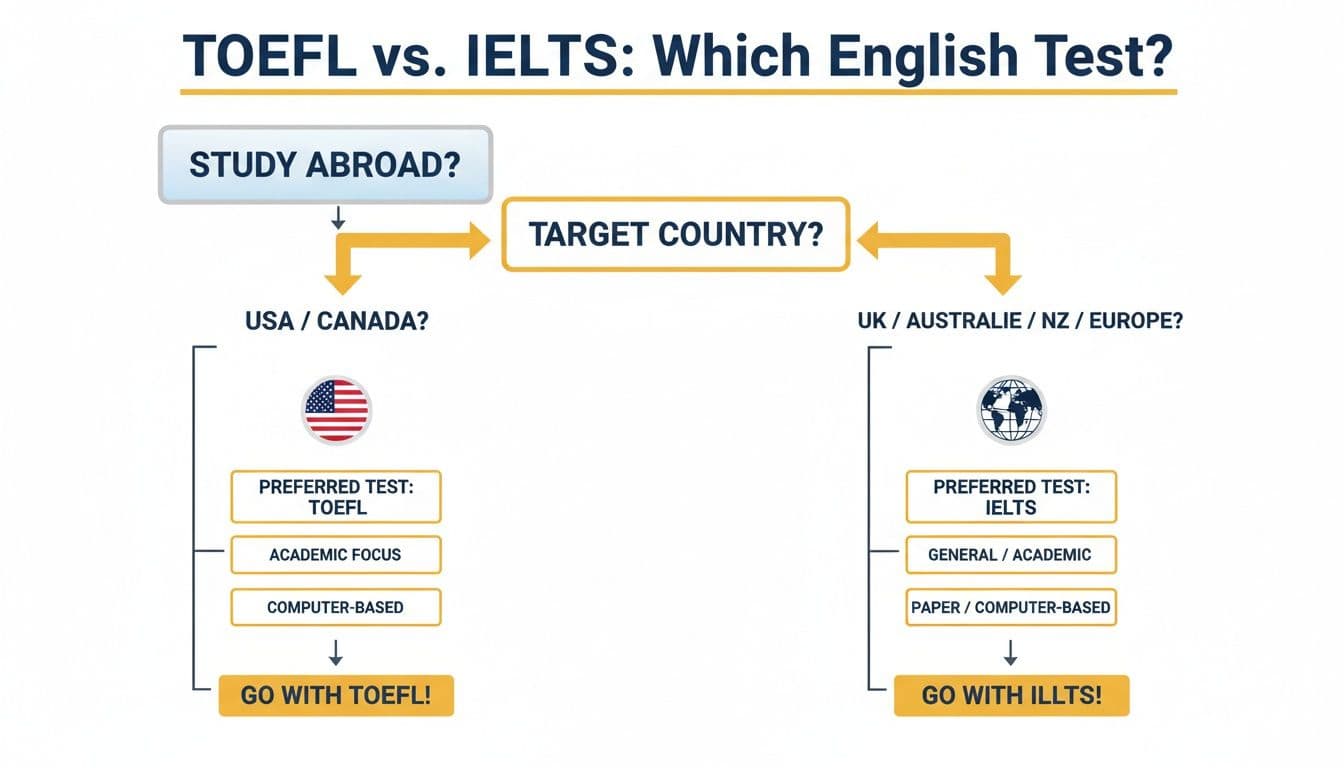
For many students, the deciding factor is geography. This decision tree lays it out clearly.

As you can see, your primary destination—the US versus the UK, Australia, or New Zealand—is the best place to start. University acceptance data backs this up, showing clear regional preferences that can make your life a lot easier.
For decades, the TOEFL has been the gold standard for American university admissions. Virtually every U.S. university accepts it. While IELTS is gaining ground globally, TOEFL’s deep-rooted acceptance in the States still makes it the go-to choice for anyone with their sights set on a U.S. degree.
To give you a clearer picture, here’s a quick summary of the key differences you need to know for the 2026 testing year.
TOEFL vs IELTS Key Differences at a Glance for 2026
This table breaks down the most important distinctions between the TOEFL iBT and IELTS Academic tests.
| Feature | TOEFL iBT (2026 Format) | IELTS Academic |
|---|---|---|
| Primary Acceptance | Strongest in the USA & Canada | Strongest in the UK, Australia, & NZ |
| Test Format | Computer-based only | Computer or paper-based |
| Speaking Test | Recorded responses into a microphone | Live interview with a human examiner |
| Writing Tasks | Three short tasks (Build a Sentence, Write an Email, Academic Discussion) | Two tasks (Describe a chart, Write an essay) |
| Total Test Time | Under 2 hours | Approx. 2 hours 45 minutes |
Understanding these high-level differences is your first step. It's also crucial to know that the TOEFL underwent major changes that took effect on January 21, 2026. The test is now much shorter and features entirely new writing tasks that demand a different kind of preparation.
You can get the full rundown on what’s new in our complete guide to the TOEFL 2026 changes.
Comparing Test Structures and Time Management

Knowing the flow of your test day is one of the best ways to walk in feeling confident and prepared. When you stack up TOEFL vs. IELTS, one of the biggest differences you’ll find is the total time commitment and the test-day environment itself. Each exam has its own rhythm, and you need to be ready for it.
The 2026 TOEFL iBT is a sprint. At under 2 hours, it’s a completely digital experience built for speed and focus. You'll tackle every section—Reading, Listening, Speaking, and Writing—on a computer in one go at a test center. With no scheduled breaks, building your mental stamina for this short but intense format is absolutely critical.
On the other hand, the IELTS Academic feels more like a middle-distance race, clocking in at around 2 hours and 45 minutes. That extra time means the pace can feel a bit more relaxed, which some test-takers definitely prefer.
Test Environment TOEFL vs IELTS
A huge point of comparison is how the test is delivered. Your comfort level with a computer versus a good old-fashioned pen and paper could genuinely impact your score.
- TOEFL iBT: This test is 100% computer-based. You'll type every single answer, including your writing tasks, and speak into a headset microphone for the Speaking section.
- IELTS Academic: Here, you get a choice. You can opt for the computer-delivered version, which mirrors the TOEFL experience, or you can choose the traditional paper-based exam and write everything out by hand.
The most critical environmental difference comes down to the Speaking section. On the TOEFL, you speak into a microphone by yourself. For the IELTS, you have a live, face-to-face conversation with a human examiner. Many find this feels far more natural and less like a performance.
If you want a more granular look at the timing for each section of the shorter TOEFL exam, check out our guide on how long the TOEFL test is.
Ultimately, deciding between a fast-paced digital test and a longer one with a live speaking component comes down to you. Think about which environment will let your skills shine. Visualizing your test day and practicing under similar conditions will help you feel in control, no matter which exam you choose.
Understanding the New TOEFL vs IELTS Scoring Systems
Scoring is often the most confusing part of the TOEFL vs. IELTS debate, but figuring it out is essential for setting a realistic goal. Don't worry—we'll break down exactly what you need to aim for on both tests.
The two tests have always used different scoring models, and with the TOEFL's recent overhaul, knowing the difference is more important than ever.

Historically, TOEFL used a 0–120 scale, while IELTS has always used a 0–9 band system. But as of January 21, 2026, the TOEFL now uses a 1.0 to 6.0 scale with half-point increments (like 4.5, 5.0, 5.5).
This is a massive shift. A competitive score on the new TOEFL is now 5.0 or higher, a far cry from the 94–109 range students used to target.
Decoding the New TOEFL 2026 Score Bands
For the 2026 TOEFL, you get a single, holistic score from 1.0 to 6.0. This one number represents your overall English ability across all sections, replacing the old total score out of 120.
IELTS, on the other hand, gives you an individual band score from 0 to 9 for each of the four sections: Reading, Listening, Speaking, and Writing. Your final score is simply the average of those four, rounded to the nearest half-band. For instance, if you score 7.5, 7.0, 6.5, and 7.0, your overall IELTS band score is 7.0.
The big takeaway here is that the new TOEFL system simplifies your target. Instead of aiming for a high three-digit number, your focus is now on hitting a single-digit band like 5.0 or 5.5, which are the new benchmarks for many top universities.
To see how they stack up, let's look at the score equivalencies. This helps you understand what admissions committees are looking for, no matter which test they prefer. If you're wondering what it takes to get a perfect score, you can learn more about achieving a TOEFL max score in our detailed guide.
TOEFL vs IELTS Score Concordance Table
Here’s a general breakdown of how the new TOEFL 2026 scores map to the IELTS 0-9 bands. Use this table to set your target.
| TOEFL iBT Overall (1.0–6.0 Scale) | IELTS Academic Band (0–9 Scale) | General Proficiency Level |
|---|---|---|
| 6.0 | 8.5–9.0 | Expert / Mastery (C2) |
| 5.5 | 7.5–8.0 | Very Good / Advanced (C1) |
| 5.0 | 7.0 | Good / Advanced (C1) |
| 4.5 | 6.5 | Competent / Upper-Intermediate (B2) |
| 4.0 | 6.0 | Competent / Upper-Intermediate (B2) |
As you can see, a TOEFL score of 5.0 is the direct equivalent of a highly respected 7.0 on the IELTS. If you're aiming for a competitive graduate or undergraduate program, targeting a 5.0 or higher is a solid strategy.
A Head-to-Head Comparison of the Writing Sections
For most students, the Writing section is where the nerves really kick in. And when you're staring down TOEFL vs. IELTS, the writing tasks couldn't be more different. This is especially true for the 2026 TOEFL, which has completely new tasks.
This isn't just about what you write, but how you're expected to write. The 2026 TOEFL is all about quick, practical communication, while IELTS Academic rewards traditional, structured essays. Getting a feel for each test's philosophy is the key to picking the right one for your skills.
The 2026 TOEFL Writing section is a fast-paced, 23-minute sprint. It’s entirely computer-based and throws three short tasks at you designed to mimic real-world university communication. It’s all about practicality and your ability to think and write clearly under pressure.
On the other hand, the IELTS Academic Writing section is a more traditional, 60-minute marathon. You'll tackle two very different tasks: one where you analyze data and another where you build a formal argument. It gives you more breathing room to develop your thoughts but demands a solid grasp of academic writing conventions.
TOEFL Writing: The 2026 Tasks
The 2026 TOEFL Writing format is a total overhaul. Forget long, winding essays. These tasks are short, focused, and designed to test skills you’ll actually use in a university setting. According to the official ETS rubric, your score hinges on your ability to use grammar correctly, build a clear point, and communicate effectively.
Here are the three task types you'll face:
Build a Sentence: This task is a direct test of your grammar and word order. You’re given a handful of scrambled words and have to click and drag them into a single, grammatically perfect sentence.
- Actionable Tip: Practice identifying the subject, verb, and object in scrambled phrases. This is a core skill you can drill right now to improve your speed.
Write an Email: A very practical task. You'll have to write a short email (around 100 words) responding to a situation, like a question from a professor or a campus announcement. It’s a measure of your ability to be clear and professional.
- Actionable Tip: Create a template for common email scenarios (asking for clarification, requesting an extension). Having a structure in mind like
[Greeting] -> [Acknowledge their message] -> [State your main point/question] -> [Propose a next step] -> [Closing]saves you precious time.
- Actionable Tip: Create a template for common email scenarios (asking for clarification, requesting an extension). Having a structure in mind like
Academic Discussion: You’ll read a short post from a professor and two student replies. You then have just 10 minutes to write your own opinionated response of at least 100 words, contributing to the conversation.
- Actionable Tip: Don't just agree or disagree. Your goal is to add to the discussion. Practice using phrases like "Building on [Student]'s point..." or "While I see [Student]'s perspective, it's also important to consider..."
To get a better sense of what a top-scoring Academic Discussion response looks like, check out this example.
Sample Response (Academic Discussion): "I agree with Maria that exploring renewable energy sources is a critical step forward, but I think David’s point about the immediate economic impact can’t be ignored. While the long-term environmental benefits are clear, transitioning to renewables requires significant upfront investment that can affect local economies, especially in regions dependent on traditional energy jobs. A balanced approach would be to implement government subsidies for renewable energy projects while also funding retraining programs for workers in the fossil fuel industry. This way, we can pursue a sustainable future without leaving communities behind."
This response works because it doesn't just state an opinion. It directly engages with both Maria and David, then proposes a thoughtful solution that considers both sides. The only way to get comfortable with these new tasks is through focused practice. Using a platform like Writing30.com gives you unlimited practice questions for all three 2026 TOEFL task types with instant, AI-powered feedback.
IELTS Writing: Traditional Academic Tasks
The IELTS Academic Writing section sticks to a more conventional, two-part structure. You’ll have a pen and paper (or a basic word processor on the computer-based test) and one hour.
- Task 1 (20 minutes): You’ll be presented with a graph, table, chart, or diagram. Your job is to describe and summarize the key information objectively in at least 150 words.
- Task 2 (40 minutes): This is the classic academic essay. You’ll write a formal essay of at least 250 words responding to a specific point of view, argument, or problem. This task carries twice the weight of Task 1 in your final score.
The big question in the TOEFL vs. IELTS writing debate comes down to this: which style fits you better? The 2026 TOEFL rewards nimble, precise writing under a tight deadline. IELTS gives you more time to build a case but expects a more detailed, structured, and formal response.
To nail your TOEFL writing, you first need to know exactly what the graders are looking for. We break it all down in our guide on the official TOEFL writing rubrics explained.
Comparing the Reading, Listening, and Speaking Modules
Beyond the writing tasks, the other sections in the TOEFL vs. IELTS debate offer completely different test-day experiences. Your comfort level with dense academic content, a variety of accents, and speaking under pressure can make one test a much better fit.

Let's break down how the Reading, Listening, and Speaking sections stack up. Honestly, feeling confident in the format is half the battle to getting your target score.
Reading and Listening Differences
The TOEFL Reading section is all business, focusing purely on academic passages. You’ll read excerpts that feel like they're straight out of a university textbook, then answer standard multiple-choice questions. It’s a straightforward format that rewards your ability to quickly read and understand dense, scholarly material.
IELTS Reading, on the other hand, mixes things up. You get a much wider variety of texts and question types. One minute you could be reading a newspaper article, the next a journal entry. You'll have to tackle tasks like:
- Matching headings to specific paragraphs
- Answering True/False/Not Given statements
- Completing sentences and summaries
This variety can be a good or bad thing. If you find endless multiple-choice questions a grind, the IELTS format might feel more engaging. But mastering all the different question types, especially the tricky "Not Given" ones, takes serious, dedicated practice. For a deep dive into TOEFL's specific format, check out our complete guide to the TOEFL 2026 Reading section.
The contrast continues in the Listening section. TOEFL sticks to its academic lane, featuring lectures and conversations you’d hear on a university campus. IELTS Listening throws a wider net, including social situations and everyday transactions alongside academic talks. It's also famous for its mix of global accents—get ready for British, Australian, and American English.
The Speaking Section Showdown
This is arguably the biggest differentiator, and your personal preference here could be the deciding factor.
- TOEFL Speaking: You’ll speak into a microphone for about 8 minutes. All your responses are recorded and graded later by a mix of AI and human raters. You’ll be asked to give your opinion and talk about your experiences, often after seeing or hearing a short prompt.
- IELTS Speaking: This is a live, 11-14 minute interview with a human examiner. It’s designed to feel more like a natural conversation, starting with an introduction, moving to a short talk you prepare for, and ending with a back-and-forth discussion.
The right choice here really boils down to your personality. If a face-to-face interview makes your palms sweat, the TOEFL's impersonal, computer-based format might help you stay focused. On the other hand, if talking to a machine feels awkward and you thrive in a real conversation, the IELTS interview is where your communication skills will truly shine.
Ultimately, neither test is universally "easier"—the challenge just lies in different places. TOEFL demands quick thinking and comfort in a fully digital, academic world. IELTS requires you to be adaptable across various question formats and to perform well in a more conversational, human-to-human setting. Think about which environment will cause you less stress and let you perform at your best.
Which Test Score Better Predicts Academic Success?
Beyond getting into your target university, there’s a bigger question: which test score, TOEFL or IELTS, actually predicts how well you’ll do in your classes? Both are trusted exams, but some research suggests a slight edge for one over the other in forecasting your future grades.
Let's be clear: this isn't about one test being "better." It’s about what your preparation focuses on. The real key to a high GPA isn't just a high test score; it’s developing genuine English skills that last long after exam day.
So, what does the research show? One major study comparing IELTS and TOEFL as predictors of academic success found that the link between IELTS scores and a student's Grade Point Average (GPA) was moderately strong. In contrast, the connection between TOEFL scores and GPA was relatively weak.
Building Skills Over Memorizing Answers
What does this actually mean for you, especially with the 2026 TOEFL? It means your TOEFL score is the key that opens the door, but it's your real-world English ability that will help you succeed once you're inside. The new TOEFL format, with its focus on practical tasks, is designed to encourage exactly this kind of skill-building.
The goal isn't just to pass an exam. It's to thrive in an English-speaking academic environment. That means clearly communicating ideas, joining discussions, and writing well under pressure—the very skills you need to earn top marks in your degree program.
This is exactly why targeted, smart practice is so important. The best prep tools today bridge that gap between just studying for a test and actually building academic skills. When you practice with feedback that’s tied directly to the official scoring rubrics, you’re not just cramming for an exam. You’re building the writing foundation you'll rely on for your entire university career.
That’s precisely what a platform like Writing30 was built for. It gives you instant, AI-powered feedback on the new 2026 TOEFL Writing tasks, turning every practice session into a genuine learning opportunity. You’re not just learning how to beat the test; you’re becoming a more confident, effective academic writer.
Ready to build the writing skills that lead to real academic success? Start with free practice questions on Writing30.com and get an instant analysis of your writing today.
Your TOEFL vs IELTS Questions Answered
Still deciding between TOEFL and IELTS? Let's clear up the most common questions students have so you can choose the right test with confidence. We know this can be a stressful decision, but you've got this.
Is TOEFL or IELTS Easier?
There's no objectively "easier" test. The right exam is the one that best matches your specific skills and test-taking style.
TOEFL could be a better fit if: You type quickly, are comfortable with academic English, and prefer a fully digital test where you speak into a microphone. The shorter 2026 format is also a big plus if you get fatigued easily.
IELTS might feel more natural if: You prefer a real, face-to-face speaking interview, enjoy a broader range of reading topics, and like having the option of a paper-based exam.
The single best way to know is to try official practice questions for both. See which format feels less intimidating and plays to your strengths.
Which Test Should I Take for US Universities in 2026?
For US universities, the TOEFL is still the most widely accepted and often preferred exam. While nearly all American schools now accept IELTS scores, choosing TOEFL can sometimes make for a smoother application process if you're only applying to institutions in the United States.
That said, you must always check the specific admissions requirements on your target university's website before registering for any test. Don't leave it to chance.
How Should I Prepare for the New TOEFL 2026 Writing Tasks?
General English writing practice won't cut it. The new Build a Sentence, Write an Email, and Academic Discussion tasks are unique to the 2026 TOEFL format, so you need to master them under timed conditions.
The most effective strategy is using a platform built specifically for the new 2026 format. This ensures you're practicing the exact task types you'll face on test day and getting feedback that's actually relevant to the official scoring rubrics. This is exactly what our tools at writing30.com are designed to do, helping you build confidence with every practice question.
Ready to master the new TOEFL Writing section? Writing30 offers unlimited practice for all 2026 tasks with instant, AI-powered feedback aligned with official rubrics. Start with our free practice questions and see how you score at writing30.com.
Ready to Practice?
Try all 3 TOEFL 2026 writing tasks with instant AI feedback.
Tags
Ready to Improve Your TOEFL Writing?
Get instant AI-powered feedback on your TOEFL writing. Practice with real prompts and see your score improve.
Try Writing30 AI