Unlocking the TOEFL Max Score for 2026
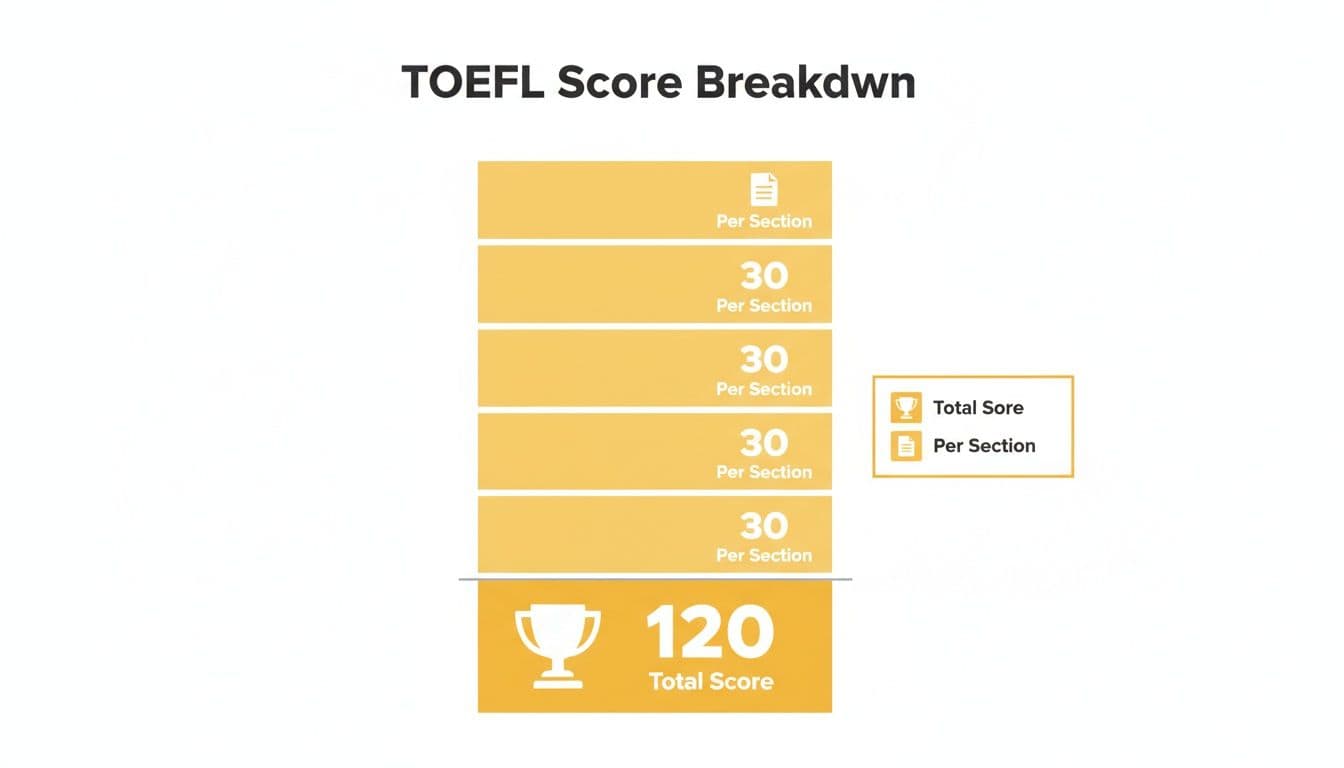
The TOEFL max score is 120. That’s the perfect score—30 points from each of the four sections: Reading, Listening, Speaking, and Writing.
But let’s be real. While aiming for 120 is an excellent goal, the number that truly matters is the one your dream university requires. Don't let the pressure of a perfect score overwhelm you. Think of the maximum score not as an impossible peak, but as a North Star guiding your preparation. You can and will achieve the score you need.
What the TOEFL Max Score Means for You
Understanding the 120-point structure is the first step in building a smart, effective study plan. It’s a simple system, really. Your total score is just the sum of your performance in four key skill areas.
Here's a quick look at the maximum score you can get for the total test and for each section.
TOEFL iBT Max Score Breakdown (2026 Format)
| Test Component | Maximum Score |
|---|---|
| Total Score | 120 |
| Reading | 30 |
| Listening | 30 |
| Speaking | 30 |
| Writing | 30 |
Each section is scored on a scale of 0-30. Your goal isn’t necessarily to achieve perfection but to build a strategy that gets you to your target score. It's all about being strategic and practicing the right skills.
Hitting that elusive 120 is incredibly rare. To put it in perspective, the average TOEFL score for all test-takers in recent years was just 88. This means a well-prepared student like you can easily score well above average with focused effort.
This guide will break down what it takes to earn a top score, with a special focus on the updated 2026 writing tasks. For a detailed look at these changes, check out our complete guide on the TOEFL 2026 updates. My goal here is to show you that a high score is within reach and that your target score is more important than a perfect one.
How to Interpret Your TOEFL Score Beyond the Numbers
Getting your score report is a big moment. You see the number, but what does it really tell you? A score of 105, for instance, feels great, but its true power comes from context. It's not just a number—it’s where you rank among everyone else who took the test.
This is where percentiles come in. They tell you exactly what percentage of test-takers you scored higher than. If you’re in the 90th percentile, it means you outperformed 90% of the competition. That’s the kind of data that makes an admissions officer sit up and take notice, moving your file from the "maybe" stack to the "yes" stack.
The total score itself is built from four simple, equal parts.

As you can see, hitting the toefl max score of 120 means scoring a perfect 30 in all four sections.
From Good to Elite Scores
While aiming for a perfect score is a great motivator, what counts as "good" really just depends on your target universities. For most graduate programs, a score in the 100-109 range is considered highly competitive.
But percentiles reveal the real story. A score of 112 catapults you into the 96th percentile, while a 104 puts you at the 87th. It's eye-opening to realize that the recent global average score of 88 only lands in the 56th percentile. You can dig deeper into score benchmarks for different programs to see exactly where you need to be.
Knowing these numbers turns vague anxiety into a clear, actionable plan. It helps you set a goal that’s not just ambitious, but realistic for the schools you're aiming for. The goal isn’t just to get a perfect score—it’s to get the score that makes you an undeniable candidate.
Want to see how your own writing measures up? You can get instant, rubric-aligned feedback on your practice tasks, including the new 2026 formats, over at Writing30.com.
Mastering the 2026 TOEFL Writing Section
The Writing section is where many test-takers feel the most pressure, especially with the 2026 format changes. But you can do this! Nailing a top score of 30 isn't about writing one perfect essay anymore. It's about showing you're a flexible, skilled communicator across three very different tasks.
Let's break down exactly what you need to do.

Your journey to a perfect 30 in Writing starts with understanding what ETS is really looking for. It’s not just about having good English; it’s about perfectly matching your response to the specific demands of each prompt.
The Three Writing Tasks for 2026
Starting January 21, 2026, the TOEFL Writing section will feature three tasks designed to mirror real-world and academic communication.
- Build a Sentence: This task is a pure test of your grammatical precision. You’ll be given words and phrases and must arrange them into a single, grammatically perfect sentence.
- Write an Email: Here, you'll need to write a response to a common situation in about 100 words. The key is using the right tone (e.g., formal and polite) and clearly achieving the prompt's goal.
- Academic Discussion: This is the most complex task. You'll read a short post from a professor and two students, then add your own contribution of about 100 words. Your goal isn't just to state an opinion but to add real value to the conversation.
Success across these tasks comes down to grammar, vocabulary, and your ability to give the graders exactly what they asked for. And if you're looking to boost your word bank, check out our guide on how to remember vocabulary efficiently for the test.
Examples of High-Scoring Responses
So, what does a top-scoring response actually look like in practice? Let's look at some examples you can model.
Build a Sentence: Imagine you’re given the pieces "the university canceled classes," "due to a severe snowstorm," and "which was unexpected." A perfect answer combines these logically and flawlessly.
- Actionable Tip: Practice identifying the main clause first. Here, it’s "the university canceled classes." Then, attach the dependent clauses correctly.
- Sample Response: "Due to a severe snowstorm, which was unexpected, the university canceled classes."
Write an Email: Suppose your professor asks for volunteers for a research project, but you need more information before committing.
- Actionable Tip: Always structure your email: greeting, state purpose, ask questions, and a polite closing.
- Sample Response:
- Dear Professor Smith,
- Thank you for the opportunity to volunteer for your research project. I am very interested.
- Before I commit, could you please clarify if the work can be done remotely?
- Thank you for your time.
- Best regards,
- Alex
Academic Discussion: In a discussion about the impact of remote work, a student argues it's always better for work-life balance. Your task is to add a new idea.
- Actionable Tip: A strong post never just rehashes what others have said. Bring a new angle or a thoughtful counterargument.
- Sample Response:
- I agree with Sarah that remote work can improve work-life balance, but I think it also introduces new challenges. For example, the line between home and office can blur, leading some people to work longer hours than they would in a traditional office. This suggests that discipline is key to making remote work a true benefit.
Mastering these new tasks is all about targeted practice. Using a tool like Writing30.com gives you unlimited cracks at these new formats with instant, rubric-based feedback. Give a few free practice questions a try right now and see exactly where you stand.
How AI and Human Raters Score Your Writing
Ever wonder who’s actually reading your TOEFL responses? It's not just one person. ETS uses a hybrid system that combines an AI scoring engine (e-rater®) with certified human raters.
Think of it as having two judges. To get a top score, you need to know what each one is looking for.
The e-rater® AI is like a strict grammar coach. It focuses on the technical side of your writing—things it can easily measure.
- Grammar & Mechanics: It scans for any mistakes in punctuation, spelling, and sentence structure.
- Sentence Variety: It checks if you're mixing up your sentences. Are you using a good blend of simple, compound, and complex structures?
- Vocabulary Range: It looks at the words you use. Are they appropriate for the topic and used correctly?
The human rater, on the other hand, is your audience. They read for meaning and logic, a lot like a professor would. They focus on the quality of your ideas and whether you fully and accurately answered the prompt.
Writing for Two Audiences
This means you’re essentially writing for two different readers at the same time. You need clean grammar and sentence variety to please the AI, but you also need strong, logical arguments to convince the human.
For instance, a response with perfect grammar might get a great score from the AI. But if the ideas are off-topic or just repetitive, the human rater will dock points. You absolutely have to nail both sides to score high.
This "dual-judge" approach is what makes the scoring fair and consistent. The AI provides an objective look at your language mechanics, while the human ensures your ideas make sense. We break this down even further in our complete guide on how the TOEFL Writing section is scored.
This is precisely the model we built our practice tools on at Writing30.com. Our AI doesn't just check your grammar and vocabulary; it also evaluates how well you've developed your argument, mimicking how the real TOEFL system works. It’s the perfect way to practice pleasing both the machine and the human rater.
Real-World Strategies for a Higher TOEFL Score
Knowing the theory is one thing, but getting a top TOEFL score—even that perfect 120—comes down to using smart, focused strategies you can put into practice today. Let's get practical and look at actionable tips for each section of the 2026 exam.

While every section is worth 30 points, the Writing section is often where students can make the biggest and fastest gains, especially with the new tasks that will be on the test starting January 21, 2026.
Your Toolkit for the 2026 Writing Section
For the updated 2026 Writing section, your strategy needs to be sharp and precise. These quick tips will help you walk into test day feeling ready and confident.
- Build a Sentence: Don't just make a long sentence; make a perfect one. The goal is flawless grammar and logic. Practice This Now: Take two related simple sentences and combine them using different conjunctions (e.g., "because," "although," "while").
- Write an Email: Keep it simple and professional. Always follow a basic structure: greeting, purpose, details, and a closing. Practice This Now: Write a 100-word email to a professor asking for an extension on an assignment. Focus on a polite and respectful tone.
- Academic Discussion: Your mission here is to add new value. Simply agreeing with another student isn't enough. Practice This Now: Read a comment on a news article. Write a 100-word response that acknowledges their point but introduces a new perspective or a counter-argument.
Looking at global TOEFL score statistics shows just how much targeted practice matters. A score of 22 in Reading is only average (50th percentile), but a 30 in Speaking puts you in the 99th percentile. For the new 2026 Writing section, this means using tools that give you instant, rubric-aligned feedback is the fastest way to jump from an average score to a truly competitive one.
To get your score climbing, it helps to have a clear game plan. Here’s a breakdown of the single most effective strategy you can practice for each section.
Score-Boosting Strategies for Each TOEFL Section
| Section | Top Strategy | Practice Focus |
|---|---|---|
| Reading | Active Note-Taking | Instead of just copying text, jot down the main idea of each paragraph and how it connects to the previous one. |
| Listening | Map the Conversation | Don't just write words. Use arrows and symbols to show relationships, like cause-and-effect or problem-solution. |
| Speaking | Use Simple Templates | For opinion questions, use a structure like: “In my view…” » “My main reason is…” » “On top of that…” |
| Writing | Focus on Adding Value | For the Academic Discussion, always reference another student’s point before adding your own unique idea. |
These strategies aren't magic—they only work if you make them a habit through consistent practice. You've got this!
Remember, quick wins can be found in every section.
Reading & Listening Pro Tip: Don't try to write everything down. Listen or read for keywords, main points, and the relationships between ideas. This makes finding answers later much faster and more accurate.
For Speaking, having a go-to structure reduces stress. Using simple frameworks helps you sound organized and confident, even when the clock is ticking.
Of course, knowing the strategies is only half the battle. You have to practice them. The AI tools at Writing30.com are built for exactly this kind of focused training on the new 2026 writing tasks. You get unlimited practice and instant score feedback, so you can see exactly what you need to do to improve. Start practicing with our free questions today.
How to Turn Practice into a Top Score
Getting a top score on the TOEFL, even a perfect 30, isn't about some secret trick. It comes down to smart, focused practice. First, you need to understand exactly what the official rubrics are looking for. Then, you have to practice hitting those targets over and over again.
Knowing the theory is one thing, but performing under the pressure of the clock is a completely different challenge. You need a way to close the gap between what you know and what you can do on test day.
From Knowing the Rubric to Earning the Points
This is exactly why we built the practice tools at Writing30.com. They're designed to help you master the specific skills needed for the 2026 TOEFL writing tasks.
- Instant Scoring: Get immediate, rubric-aligned scores for the Build a Sentence, Write an Email, and Academic Discussion tasks. No more guessing how you did—see your estimated score in seconds.
- AI-Powered Feedback: Our AI works just like the official ETS e-rater®, analyzing your writing for grammar, vocabulary, organization, and how well you completed the task.
- Detailed Error Analysis: Don't just see a score; see why you got that score. We highlight specific mistakes and give you clear suggestions on how to fix your arguments and sentences.
Think of it as a personal writing coach that’s available 24/7. It gives you the targeted practice you need to find your weak spots and turn them into strengths long before your official test date.
A high score is absolutely achievable. You have the strategies, and now you have the tools. The next step is to put them into practice.
Start training with free practice questions on Writing30.com today and see for yourself how specific, instant feedback helps you improve.
Your Top Questions About TOEFL Scores, Answered
As you dig into your prep for the 2026 TOEFL, a few key questions about scores always come up. Let's tackle the most common ones head-on to give you the clarity and confidence you need.
Is a TOEFL Score of 100 Good Enough for 2026 Admissions?
Yes, absolutely. A total score of 100 is a fantastic achievement and is considered highly competitive for the vast majority of undergraduate and graduate programs. It proves to universities that you can handle the demands of an English-speaking academic setting.
That said, always check the specific requirements for your dream schools. Elite programs in the Ivy League or at schools like MIT and Stanford often set their benchmark a little higher, sometimes in the 105-110 range.
Can I Get a Perfect 30 on the New TOEFL Writing Section?
Getting a perfect 30 on the 2026 Writing section is tough, but it's definitely achievable with the right preparation. It’s the ultimate sign of mastery.
To get there, you need to excel in all three new task types: Build a Sentence, Write an Email, and Academic Discussion. This means demonstrating near-flawless grammar, using a sophisticated range of vocabulary, and crafting responses that are perfectly organized and fully achieve the prompt's goal. It’s a high bar, but with consistent, targeted practice, it’s within your reach.
Does the TOEFL Max Score Ever Change?
Nope. The toefl max score has been a steady 120 points ever since the iBT format was first rolled out back in 2005.
While ETS is always tweaking things—like the major updates to the writing tasks effective January 21, 2026—the fundamental scoring system has remained the same. Each section is still scored on a 0-30 scale, and the total score is still out of 120.
Ready to turn these insights into a higher writing score? Writing30 AI is built specifically for the new 2026 tasks, giving you the targeted practice and instant feedback you need to achieve your goals. Don't let the new format intimidate you—use it as an opportunity to shine. Try our tools for free and start improving today at Writing30.com.
Ready to Practice?
Try all 3 TOEFL 2026 writing tasks with instant AI feedback.
Tags
Ready to Improve Your TOEFL Writing?
Get instant AI-powered feedback on your TOEFL writing. Practice with real prompts and see your score improve.
Try Writing30 AI