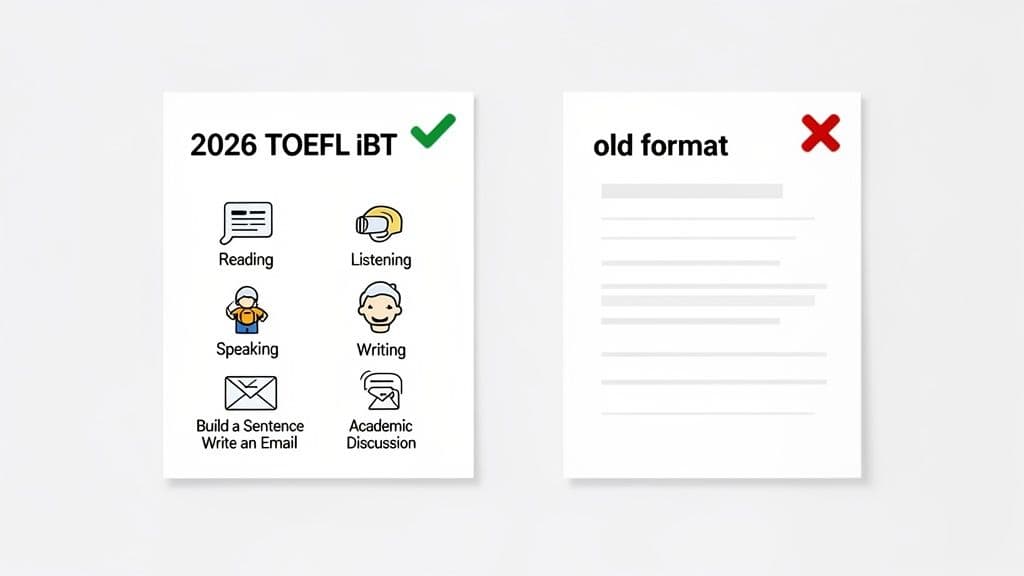
The Best Free TOEFL iBT Practice Test for the 2026 Exam
Taking on the TOEFL can feel like a huge challenge, but you've already made a great first move by looking for a free TOEFL iBT practice test. Finding the right one is crucial. Many free tests online are outdated, which means you could be practicing for an exam that no longer exists. Don't worry, we'll guide you to the resources that will truly help you succeed.
To get a real measure of your skills and build your confidence, you need a practice test that perfectly matches the current TOEFL iBT format.
Matching Your Practice Test to the 2026 TOEFL Format

Taking a practice test isn’t just about getting questions right. It's a dress rehearsal for the real thing, and doing it right can calm a lot of test-day anxiety. I’ve seen countless students feel confident after acing an old practice test, only to be completely thrown off by the new tasks and timing on exam day. You can avoid that.
The TOEFL iBT got a major overhaul on January 21, 2026. The entire exam was shortened to just under 2 hours, a big change from the marathon sessions of the past. If you find a free TOEFL iBT practice test that's longer than that, it's not worth your time.
You can see the new structure for yourself in the official practice test guidelines from ETS. Using old materials is like training for a 5k race by running a marathon—the pacing, strategy, and mental energy are all wrong.
To help you quickly check if a practice test is current, here's a simple table outlining the post-January 2026 format.
TOEFL iBT Format at a Glance (Post-January 2026)
This table breaks down the current TOEFL iBT structure. Use it as a quick checklist to verify any practice test you find.
| Section | Time Allotted | Number of Tasks/Questions |
|---|---|---|
| Reading | 35 minutes | 2 passages, 20 questions |
| Listening | 36 minutes | 2 sets of lectures/conversations |
| Speaking | 16 minutes | 4 tasks |
| Writing | 29 minutes | 3 tasks |
This structure is your new benchmark. Any deviation means the test is outdated and won't give you an accurate score.
Key Features of a 2026-Ready Practice Test
So, how do you spot a good, current practice test from a bad, old one? Look for these specific features. Anything less is a red flag.
- Total Test Time: The whole experience should clock in just under two hours. Older tests were over three hours long.
- Reading Section: It should have two passages, not three or four.
- Speaking Section: The section must have exactly four tasks and last about 16 minutes.
- Updated Writing Section: This is the most critical check. The test must include the three new tasks: Build a Sentence, Write an Email, and Academic Discussion. The old "Integrated Writing" essay is completely gone.
The goal isn't just to find any free test; it's to find the right one. An accurate practice test provides a reliable baseline score, revealing your true strengths and weaknesses so you can build a smart, targeted study plan.
Pay special attention to the Writing section. A ton of free resources still feature the old essay prompts. Practicing the old "Integrated" or "Independent" essays is a waste of your valuable study time.
These new tasks test completely different skills. To see exactly how different they are, check out our deep dive into the TOEFL 2026 format updates. Finding a practice resource that nails these new writing tasks is your secret weapon for a high score.
Where to Find Trustworthy Free TOEFL Practice Tests
Googling "free TOEFL iBT practice test" can feel overwhelming. You'll find countless links, but it’s nearly impossible to tell which ones are genuinely helpful and which are just outdated clickbait. Let's cut through the noise and zero in on the sources you can actually trust.
Your first and most important stop should always be the official ETS website. As the creators of the TOEFL, the free sample questions and practice sets they provide are the absolute gold standard for question style, tone, and difficulty. Starting with their free materials gives you the most authentic feel for the exam without spending a dime.
From there, several reputable third-party platforms offer high-quality, full-length simulations that do a great job of mimicking the real exam. Sites like TST Prep and Study.com often provide at least one complete free TOEFL iBT practice test. Taking one of these is an invaluable way to get a baseline score and really understand the test's strict pacing.
Vetting Free Practice Tests Quickly
So, how can you spot a good free test from a bad one in under a minute? Look for these three tell-tale signs to quickly check its quality:
- Updated for the 2026 Format: The test description must explicitly say it aligns with the changes made on or after January 21, 2026.
- Correct Test Length: A modern, valid test will be timed for just under two hours. Anything significantly longer is based on the old, retired format.
- The Right Writing Tasks: It has to include the new Build a Sentence, Write an Email, and Academic Discussion tasks. If you see the old "Integrated Essay," close the tab—the test is obsolete.
Starting with free resources is a smart, no-risk strategy. It lets you gauge your starting skill level, find your biggest weak spots, and get used to the test's structure before you even think about whether paid materials are right for you.
While an official practice test from ETS will run you about $45.95 a pop, the rise of quality free alternatives has made solid prep more accessible than ever. In fact, about 95% of students use at least one practice test before their exam, and most of them begin with free options to see where they stand. This has helped level the playing field for millions of students, and you can see how these resources shape study strategies in this expert analysis.
Remember, the whole point of these first few tests is diagnosis. Don't get discouraged by your initial score! It's just a starting point. The real progress happens when you analyze what you got wrong and build a study plan that targets those specific weak areas.
For more practice materials, you might also want to check out our guide on where to find TOEFL practice tests in PDF format. Using these trusted sources ensures you’re practicing with relevant, accurate materials that will set you up for success right from day one.
How to Simulate Real Test Conditions at Home

Finding a quality free TOEFL iBT practice test is a great first step, but how you take it makes all the difference. To get a score that actually means something, you have to mimic the pressure and setup of the real exam. This is the only way to find out where you lose points when the clock is ticking.
Think of it this way: don’t just squeeze a practice session in. Schedule it. Go to your calendar and block out a solid, uninterrupted two-hour window. Treat it like a doctor's appointment you absolutely cannot miss. This will help you feel prepared and in control.
This means you need to create a true "test bubble." Putting your phone on silent isn't enough—put it in another room entirely. Turn off every single notification on your computer, close all extra tabs, and hang a "Do Not Disturb" sign on your door. Let your family or roommates know you're off-limits.
Mastering the Mental Game
The psychological pressure of the TOEFL is a massive hurdle, but it’s one you can train for. Building mental stamina during your practice runs is a non-negotiable part of your preparation.
Here are some actionable tips you can use right now:
- Stick to the Clock: Use a timer and be ruthless. No pausing the test, no "just one more minute" on a tough question. If you're unsure about the timing, our guide on how long the TOEFL test takes breaks it all down. This builds the discipline you need for test day.
- Zero Outside Help: This is a big one. No dictionaries, no grammar checkers, and definitely no quick Google searches. You have to rely 100% on what’s already in your head. Trust in your preparation!
- Ditch the Pen and Paper: On the real test, you use a simple on-screen notepad. It can feel awkward at first, so practice typing your notes into a basic text box now. This prevents a nasty surprise on exam day.
The goal of a practice test isn't just to answer questions; it's to train your brain to perform under pressure. Every distraction you eliminate and every rule you follow makes your practice score a more accurate and useful tool.
When you take these steps, you’re not just taking a practice test—you’re conducting a full dress rehearsal. By the time you sit for the real TOEFL, the time constraints and on-screen tools will feel familiar. This familiarity is your secret weapon against test-day anxiety, letting you focus completely on showing off your English skills.
Analyzing Your Practice Score to Find Weaknesses
So you finished a free TOEFL iBT practice test under real conditions. Great! Remember, the score you see isn't the finish line—it's the starting block. That number is just data; the real value comes from turning it into a smart, targeted study plan.
The real work begins after you get your score. Don't just look at what you got wrong; dig into why. A highly effective habit is to keep an "error log." For every mistake, note the question type and why you think you missed it. This simple act is what separates students who improve from those who keep making the same mistakes.
Digging Deeper into Your Reading Performance
Let's start with the Reading section. For many, this is a critical part of the TOEFL. In fact, 78% of test-takers report reading as either their strongest or weakest skill. The good news is that students who complete 3-5 full-length practice tests and analyze them properly often boost their reading scores by 15-20%. It really works, and you can learn more about how these practice tests shape preparation strategies on BestMyTest.
To analyze your reading errors, you need to categorize them. Was your mistake because of:
- Vocabulary? You just didn't know a critical word.
- Inference? You failed to connect the dots on something not directly stated.
- Main Idea? You missed the overall point of a paragraph or the passage.
- Time Pressure? You knew the answer but rushed and made a careless error.
By tagging each mistake, you'll quickly see patterns emerge. If you notice a lot of 'inference' errors, you know exactly which skill to drill. This is much more effective than just randomly reading more articles.
Addressing Time Management Issues
Your error log is also a powerful tool for spotting time management problems. Did you spend five minutes on one reading question, forcing you to guess on the last five? Make a note. The TOEFL isn't just an English test; it's a test of performing accurately under pressure.
If the timer is your enemy, start practicing individual question types with a stopwatch. For example, give yourself just 60 seconds to nail a "Factual Information" question. This builds the speed and confidence you need to move through the section without getting bogged down.
This analytical approach turns a simple score into a concrete roadmap for improvement. It's also crucial to know how these practice scores stack up against the real thing, which we cover in our guide on how AI mock scores compare to the real TOEFL test. Now, let’s talk about the Writing section.
Improving Your Writing Score with AI Feedback
The biggest headache after any free TOEFL iBT practice test? The Writing section. You can score your own Reading and Listening sections, but judging your own writing can feel like a shot in the dark. This is exactly where most students get anxious, but it's also your biggest opportunity for a score boost.
Most free tests give you the prompts, but that's it. You're left guessing if your email tone was right or if your discussion post was persuasive enough. This feedback gap is a major problem, especially since the TOEFL 2026 format introduced three completely new, very specific writing tasks.
You don't have to guess. Let's walk through exactly what these new tasks are and how you can get your practice attempts graded accurately.
The Three New Writing Tasks Decoded
The post-2026 Writing section is no longer about writing long, complex essays. It’s all about practical, real-world academic communication. You need to master three specific skills.
Build a Sentence: This task directly tests your grammar and word order. You’ll be given scrambled words and must arrange them into a perfect sentence.
- Example:
of / a / the / showed / clear / the topic / understanding / student - Correct Response:
The student showed a clear understanding of the topic.
- Example:
Write an Email: You’ll face a common academic scenario and need to write a short, effective email of about 100 words. The goal is a professional yet approachable tone.
- Example Scenario: You missed a class and need to ask your professor what you missed.
- Sample Response:
Dear Professor Smith,
I am writing to apologize for my absence from your Psychology 101 class on Monday, October 26, due to a doctor's appointment. I have already reviewed the lecture slides you posted online, but I was hoping you could let me know if there were any important announcements or assignments mentioned that I should be aware of.
Thank you for your understanding.
Sincerely,
[Your Name]
Academic Discussion: In this task, you’ll read a short online forum post from a professor and two student responses. Your job is to add your own contribution, making sure to build on their ideas. You can practice this exact task type with instant feedback on our free practice tools at writing30.com.
Notice how all three tasks mimic things you’ll actually do at a university. Now, how do you find out if you're doing them correctly?
The key isn't just to practice, but to analyze your performance and target your specific weaknesses.

Taking the test is just step one. The real improvement comes from digging into your results to see what went wrong.
How AI Feedback Closes the Gap
This is where you can get a huge advantage. You can take your practice writing from any free TOEFL iBT practice test and get an instant, expert-level analysis using a dedicated AI tool.
Platforms like Writing30.com are built specifically for these new 2026 TOEFL tasks. You simply finish a practice question, paste your writing into the tool, and in seconds, you get a full report with a score estimate.
An AI writing tool doesn't just give you a score; it shows you why you got that score. It analyzes your work against official ETS rubric criteria, pinpointing exact areas for improvement in grammar, vocabulary, organization, and task fulfillment.
For instance, the AI might flag that your email came across as too informal, or that you used the same vocabulary over and over. It might show you where your argument in the Academic Discussion task was weak. This is the kind of specific, actionable feedback that builds skills and confidence.
To truly understand what the raters are looking for, you need to get familiar with the grading system. You can dive deeper with our complete guide to the official TOEFL Writing rubrics.
By using AI feedback on every practice attempt, you start to see the test through the eyes of a scorer. You’ll learn to identify your own common mistakes and fix them, turning your biggest writing weaknesses into strengths. That's how you build the confidence to walk into test day and nail the Writing section.
Answering Your Questions About Free Practice Tests
As you start prepping, it's natural to have questions about using a free TOEFL iBT practice test. You want to know your study time is well-spent. Let's tackle some of the most common questions with supportive, actionable advice.
Simply taking one test after another won't get you far. The real progress comes from treating each practice test as a deep learning opportunity, not just a quiz.
How Many Free Practice Tests Should I Take?
Stick to the sweet spot: aim for 3 to 5 full-length practice tests during your entire study period. Any more than that often leads to burnout without much added benefit. Remember, quality over quantity is the goal here.
A supportive schedule looks like this:
- Test #1 (Diagnostic): Take this right at the beginning. It gives you a baseline score and shows you exactly where your strengths and weaknesses are. Don't worry about the score—it's just a starting point!
- Test #2 (Mid-Point Check): After a few weeks of drilling your weak areas, take a second test. This is your progress report. Are your strategies working?
- Test #3-5 (Final Polish): In the last few weeks before your exam, use these tests to master your timing and build the mental stamina needed for the real thing.
It's far better to analyze one test deeply than to rush through ten without learning from your mistakes. Real improvement happens when you figure out why you made an error, not just that you made one.
To avoid burnout, work on section-specific drills between full tests. If writing is your challenge, for instance, you can use the unlimited free practice tasks on Writing30.com. This lets you hone specific skills without the fatigue of a full two-hour exam.
Are Scores from Free Practice Tests Accurate?
This is a great question. The honest answer is: it depends entirely on the source. Scores from official ETS free materials are the most reliable. High-quality third-party tests can also be quite accurate, but there's more variability.
Think of a practice score as an estimated score range, not a magic number. Its true purpose isn't prediction—it's to give you performance data. It shows you which question types you consistently miss and where you’re losing time. That information is pure gold.
For the Writing section, scoring yourself accurately is nearly impossible. This is where an automated scoring engine is so valuable. A tool like the one on Writing30.com is calibrated specifically to the official ETS rubrics for the 2026 writing tasks, giving you a score estimate and feedback you can actually use to guide your studies.
Can I Improve My Score with Only Free Resources?
Absolutely! You can definitely achieve a high score using only free resources, but you have to be organized and strategic. Just randomly clicking on free exercises won't be very effective.
The key is to build a complete study system by combining different types of free materials.
Your strategy could look something like this:
- Diagnose: Use a full-length free TOEFL iBT practice test from a trusted source (like ETS) to pinpoint your weakest section.
- Learn: Find free guides, articles, and video lessons that teach the strategies for the areas where you're struggling.
- Drill: Use targeted free practice tools to work on those specific skills over and over until they feel automatic. For writing, you can practice individual tasks on our tools at writing30.com.
For example, if the new Academic Discussion writing task is giving you trouble, you can practice it for free on Writing30.com as many times as you want. This cycle of diagnosis and targeted drilling is the single most efficient way to turn weaknesses into strengths without spending a dime. You can do this!
Ready to put this into practice? Stop wondering about your writing skills and start getting real, specific feedback. Writing30 AI gives you instant, rubric-based scores for all the new 2026 TOEFL writing tasks. Try our free practice tools at writing30.com today and see exactly what you need to do to boost your score.
Ready to Practice?
Try all 3 TOEFL 2026 writing tasks with instant AI feedback.
Tags
Ready to Improve Your TOEFL Writing?
Get instant AI-powered feedback on your TOEFL writing. Practice with real prompts and see your score improve.
Try Writing30 AI